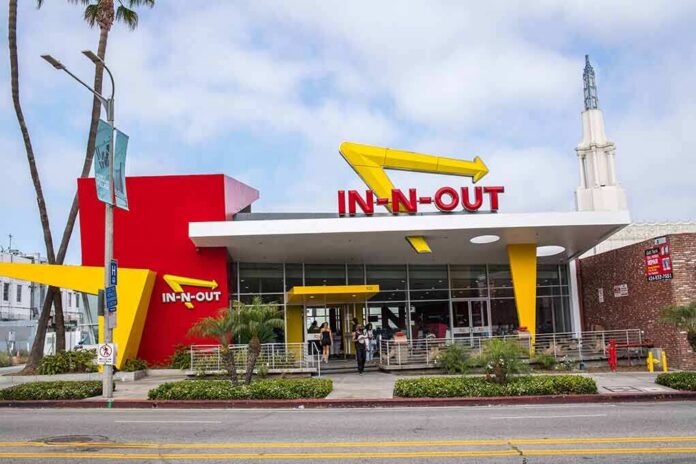
A quiet Saturday at a new In-N-Out Burger in Idaho turned into a deadly war zone that was only contained when an off-duty trooper and an armed citizen shot back.
Story Snapshot
- Three people were killed and seven injured in a mass shooting at an In-N-Out in Twin Falls, Idaho.
- Police say 24-year-old Chad Williams opened fire and then died from a self-inflicted gunshot.
- An off-duty state trooper and a legally armed bystander returned fire and likely kept the death toll from climbing.
- The attack deepened public anger over rising violence and a government seen as unable to keep everyday places safe.
Deadly attack at a busy Twin Falls In-N-Out
On Saturday afternoon in Twin Falls, Idaho, a normal rush at a newly opened In-N-Out Burger turned into terror when a gunman began firing inside and around the restaurant. Police say three people were killed and seven others were wounded before the shooting stopped. Videos from the scene show customers sprinting from the building as shots ring out and cars try to flee the parking lot. The restaurant sits in a busy shopping area, so many families and travelers were nearby when the attack began.
City officials say the first 9‑1‑1 calls reported an active shooter at or near the In-N-Out just after 2:30 p.m. local time. Twin Falls Police Chief Matthew Hicks later told reporters there were three deceased victims and seven injured, with two treated and released, three in stable condition, and two in critical condition. St. Luke’s Magic Valley Medical Center received several of the wounded for emergency care. Authorities quickly shut nearby roads, including the bridge that links the city to the interstate, to keep people away while officers searched the area.
Shooter identified and motive still unknown
By Sunday, Chief Hicks confirmed the suspected gunman was 24‑year‑old Chad Williams, a local resident. Police say Williams died from a self-inflicted gunshot wound after the attack and that detectives are confident he acted alone. The chief noted that Williams’ family is fully cooperating with the investigation, but officials still have not shared a clear motive for why he opened fire on strangers at a fast-food restaurant. Early reports even struggled to confirm whether the shooter’s death was included in the fatality count, showing how chaotic the first hours were.
Investigators are now working through security video, witness statements, and social media clips to piece together the timeline of the attack. One widely shared video shows a man with a long gun firing toward parked cars and opening the door of a sedan as people try to escape. Another clip appears to capture the moment he shoots toward Tesla owners at nearby charging stalls, sending them scrambling for cover. Police have pushed back on online rumors, stating that some names shared as “the shooter” on social media are completely wrong and not involved in the incident.
Armed bystanders confront the gunman
Chief Hicks said two people at or near the restaurant fought back: an off-duty Idaho State Police trooper and a civilian who was legally carrying a firearm. Both returned fire at Williams during the attack, forcing him to move away from the restaurant and likely saving lives inside. Hicks publicly praised their actions, calling them heroic and saying their quick response probably kept the casualty numbers from rising even higher. Social posts and local interviews now describe these men as “armed heroes” who stepped in when seconds mattered and help was still minutes away.
A shooting at a newly opened In-N-Out Burger in Twin Falls, Idaho, left three people dead, including an employee, and seven others injured on Aug. 1.
In-N-Out President Lynsi Snyder said her heart was broken over the loss. She said the company would mourn and pray with the… pic.twitter.com/eJhb7817Rt
— Tevin Macharia Mukabana (@TevinMacharia) August 4, 2026
Witnesses say the gunman seemed comfortable firing at cars and people until bullets started coming back toward him, at which point he changed direction and the attack shifted away from the crowded entrance. That detail hits a nerve in today’s gun debate: some see it as proof that trained and prepared citizens can stop evil faster than any government agency, while others worry that more guns at chaotic scenes could raise the risk of confusion or friendly fire. In this case, police credit the armed bystanders with limiting the damage, not making it worse.
Rising anger over safety and government failure
The Twin Falls shooting adds yet another chapter to a long list of public mass attacks in places that should feel safe: restaurants, churches, schools, theaters, and parking lots. People on the right and the left may argue about guns, but they share a core fear exposed here: you can do everything “right” and still be gunned down in a normal American setting while leaders in Washington trade talking points. Many locals now feel their daily security depends less on official protection and more on luck and on the courage of whoever happens to be nearby when violence erupts.
This reality feeds a growing sense that the federal government and the larger “system” are failing at their most basic job: keeping citizens safe enough to chase the American Dream. Conservatives see this attack as proof that crime and instability are rising despite tough talk, and that responsibly armed citizens remain a crucial last line of defense. Liberals see it as proof that everyday life has become far too dangerous and that deeper social problems—mental health, economic strain, online rage—are going untreated. Both sides look at three dead and seven injured in a burger shop and see a government that talks a lot but fixes little.
Questions that remain for Twin Falls and beyond
Investigators still have major questions to answer: why Williams chose this target, whether he had earlier warning signs, and how he obtained and carried his weapon that day. Those answers will matter not only for the families of the victims, but also for citizens everywhere who want to know whether this was preventable or simply the latest sign of a fraying system. As Twin Falls mourns, the story that sticks is simple and hard: a young man walked into a normal public space and opened fire; two armed citizens stood up to him while the rest ran for their lives.
Many Americans now see a pattern. After each mass shooting, national leaders promise “answers” and “action,” but the attacks keep coming. People watch raw video from places like Twin Falls on their phones and wonder whether the next random target will be their town, their store, or their kids’ hangout. In that climate, praise for the off-duty trooper and the armed civilian is not only about guns; it is about ordinary people stepping up when many feel the official institutions designed to protect them are slow, distant, and too tangled in politics to keep pace with real danger.
Sources:
youtube.com, latimes.com, nbcnews.com, tmz.com, wsj.com, en.wikipedia.org, cnn.com, yahoo.com, facebook.com
© conservativefreepress.com 2026. All rights reserved.