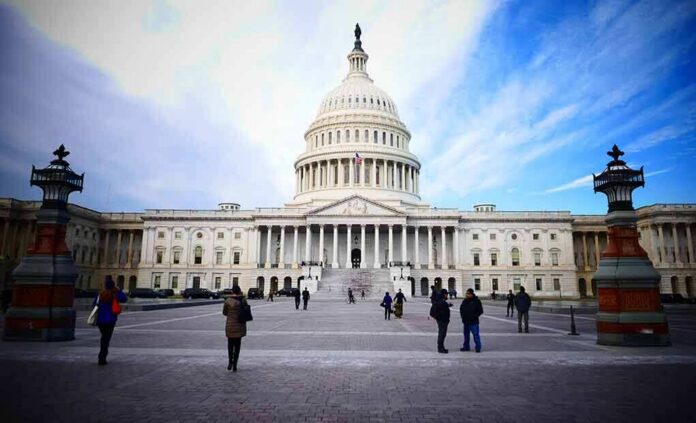
In a 51-47 party-line vote, the Senate just handed President Trump a loyal new boss over America’s spy agencies, deepening fears on both left and right that national intelligence now serves politics more than the people.
Story Snapshot
- The Senate confirmed Jay Clayton as director of national intelligence in a 51-47 party-line vote.
- Clayton refused to clearly say Joe Biden won the 2020 election, alarming Democrats and many democracy watchdogs.
- The confirmation revives lapsed warrantless surveillance powers, raising privacy and civil liberties worries.
- Both conservatives and liberals see the move as another sign Washington serves elites, not ordinary Americans.
How Clayton Won the Job and What the Senate Did
On Tuesday evening in Washington, the Senate voted 51-47 to confirm Manhattan federal prosecutor Jay Clayton as director of national intelligence, with every Republican voting yes and every Democrat voting no. This party-line vote gives Clayton control over all 18 U.S. intelligence agencies and ends weeks of temporary leadership after a stalled nomination fight. Before the final vote, senators first advanced his nomination in a 51-43 procedural vote, clearing the way for confirmation despite loud warnings from the minority party. The result fit a growing pattern: for major national security jobs, the Senate now tends to split strictly by party rather than debate each nominee’s merits in a truly independent way.
Clayton’s path to the job followed the standard steps, but in a sharply divided climate. He faced a heated public hearing before the Senate Intelligence Committee, answered hundreds of written questions, and passed a Federal Bureau of Investigation (FBI) background check, according to committee leaders. The panel then advanced his nomination on a one-vote margin, sending it to the full Senate despite united Democratic opposition. That slim committee vote signaled what was coming: a final showdown where the majority party used its numbers to push through the president’s pick, while the minority tried—and failed—to turn public pressure into votes.
Why Clayton’s 2020 Election Answers Set Off Alarm Bells
During his hearing, senators pressed Clayton on a simple, high-stakes question: did Joe Biden win the 2020 election? Clayton repeatedly refused to give a direct “yes,” instead offering vague statements about respecting “official processes” and avoiding “political judgments.” That dodge infuriated Democrats and worried many Americans who see clear acceptance of election results as a basic test for anyone trusted with secret power. Major outlets from Reuters to Politico highlighted this moment, warning it could undermine trust in intelligence at a time when faith in government is already badly shaken.
For many liberals, Clayton’s answers looked like another sign that key parts of government now bend toward the “America First” political line rather than neutral facts. For many conservatives who still care deeply about election integrity and limited government, the episode raised different but related fears: that political insiders can play games with basic truth and still get promoted. Both sides see a system where loyalty to party often matters more than loyalty to the Constitution, and this nomination fight seemed to confirm that view.
Surveillance Powers, Civil Liberties, and the Deep State Debate
Clayton’s confirmation does more than fill a chair at the Office of the Director of National Intelligence. It also restarts a bitter fight over renewing Section 702 of the Foreign Intelligence Surveillance Act, a warrantless spying authority that had lapsed. Supporters say this tool is vital to track terrorists and foreign hackers. Critics on both left and right say it has been used to sweep up Americans’ communications without a judge’s warrant, feeding the sense that a powerful “deep state” watches citizens more than foreign enemies.
[President Trump, Truth Social]
Congratulations to the Great Jay Clayton on his confirmation by the United States Senate, to be the next Director of National Intelligence. Jay is outstanding in every way, and will do a spectacular job as Director! President DONALD J. TRUMP pic.twitter.com/kNEmoy6jKi— 제리올스 (@_blue25a11) July 30, 2026
With Clayton in charge, President Trump and Republican leaders hope to push a new deal on these surveillance powers that fits their national security agenda. But millions of Americans, especially those already angry about overreach by the Internal Revenue Service (IRS), FBI, and other agencies, see this as another example of Washington growing its control while regular families struggle with wages, prices, and debt. The fact that a 51-47 vote can unlock broad spying powers, with almost half the Senate saying no, deepens the feeling that the system is rigged by and for elites.
What This Confirmation Says About Power in Washington
News reports stress that Clayton is a longtime Trump ally, a former Securities and Exchange Commission chair and Wall Street lawyer now entrusted with the nation’s deepest secrets. To many conservatives, placing a trusted supporter in this post looks like a victory against entrenched intelligence officials who they believe fought President Trump from the shadows for years. To many liberals, it looks like political capture of an office that was supposed to stand above party fights, especially when the nominee will not firmly defend past election results.
Yet beyond partisan talking points, the bigger story many Americans see is grim and familiar. Once again, a small group of powerful lawmakers made a high-impact decision after a bruising process, with almost no real say for citizens who live with the consequences. Once again, trust in government shrinks as people watch leaders argue over loyalties and surveillance tools while everyday problems—housing costs, health bills, broken infrastructure, and the fading promise of the American Dream—go largely unresolved. The 51-47 vote is simple math. The loss of shared trust it signals is much harder to repair.
Sources:
insiderpaper.com, ms.now, reuters.com, nytimes.com, politico.com, youtube.com, latimes.com, foxnews.com, c-span.org
© conservativefreepress.com 2026. All rights reserved.