

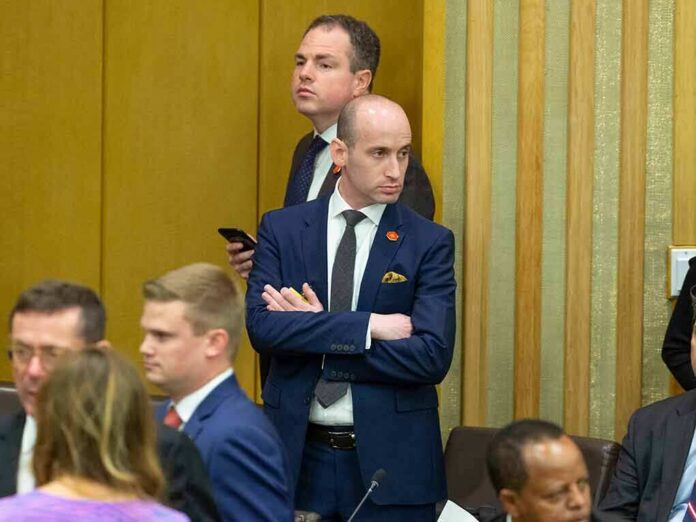
Presidential personnel moves are not just résumé swaps; they reset how the White House thinks, prioritizes, and executes. President Trump’s decision to elevate Stephen Miller to chief of staff—succeeding Susie Wiles—signals a consolidation around a trusted, ideologically aligned adviser whose portfolio has long fused policy, politics, and message discipline.
At a Glance
- President Trump named Stephen Miller the 33rd White House chief of staff, replacing Susie Wiles, with the transition set to begin the following Monday.
- Multiple national outlets independently reported the change and timing, and Miller publicly accepted the role.
- The move follows Republican midterm losses and fits a familiar pattern of post-election staff resets.
- Miller’s ascent elevates a longtime Trump adviser identified with hardline immigration policy and combative political strategy.
What Happened and Why It Matters
The White House announced that Stephen Miller, then serving as deputy chief of staff, would become the 33rd chief of staff, succeeding Susie Wiles. The announcement emphasized Miller’s tenure “since the very beginning” of Trump’s political ascent and framed him as central to the administration’s efforts on public safety, border enforcement, and anti-fraud initiatives. Independent reporting from NPR, Reuters, and others corroborated both the appointment and the planned effective date early the following week. NBC’s reproduction of the president’s statement specified Monday, November 9, 2026, as the start date. In parallel, Miller publicly accepted the elevation, and Wiles was described as transitioning to Trump’s political operation.
Why this matters is not ceremonial—chiefs of staff shape the president’s day, referee policy tradeoffs, and translate a leader’s instincts into systematized action. Choosing Miller formalizes an arrangement that has existed informally for years: a president relying on a loyal strategist steeped in the administration’s most polarizing priorities. That will likely influence not only what reaches the Resolute Desk but how aggressively the White House presses its agenda across the executive branch.
Mechanism: What a Chief of Staff Actually Controls
The modern chief of staff is the White House’s integrator. In practice that means four authorities that matter. First, gatekeeping—what memos, meetings, and interlocutors reach the president, and with what framing. Second, process control—setting policy workstreams, deadlines, and interagency clearances that determine whether rough ideas become lawful, durable directives. Third, personnel choreography—aligning senior staff and agency heads so priorities do not stall in turf wars. Fourth, crisis routing—deciding who owns response, how options are generated, and what tradeoffs are acceptable under time pressure. The title does not grant statutory power over departments, but in a presidency where loyalty and speed are prized, the chief’s convening power, plus proximity to the president, often proves decisive.
Appointing a chief who has already been a principal in policy fights compresses the distance between aspiration and execution. For Miller—widely described over two terms as an architect of immigration and law-and-order initiatives—the shift from adviser to operational commander consolidates influence at the process points where ideas become instructions to agencies.
How We Got Here: The Pattern After Political Losses
Timing is a message. Trump announced the change days after Republicans lost control of both chambers of Congress—an echo of the classic American pattern in which presidents recalibrate staff after electoral setbacks. Major outlets framed the move in exactly that context: a post-midterm reset, with Miller slated to take the reins the following Monday. In Trump’s first term, the chief-of-staff office was already a site of churn—Priebus, Kelly, Mulvaney (acting), and Meadows—so a decisive personnel pivot after an adverse election outcome fits both the historical playbook and this president’s managerial style.
What makes this iteration notable is the contrast in profiles. Wiles, frequently credited for organizational steadiness and a lower-leak, lower-drama West Wing, gives way to a figure whose public brand is not managerial equanimity but policy zeal and message combat. That choice suggests the White House expects the next phase to be defined less by legislative horse-trading with an opposition Congress and more by executive-driven initiatives, interagency maneuvering, and political confrontation.
The Miller Profile: Ideology Meets Operations
Miller has been at Trump’s side since the 2016 run-up, building a reputation as an unflinching advocate of restrictive immigration policies and a disciplined communicator of the president’s priorities. The official announcement spotlights his role in “driving” administration efforts on border enforcement and crime. Coverage across outlets featured the same core identity: a powerful domestic policy hand elevated to the post that orchestrates the White House itself.
Translating that identity into a chief-of-staff portfolio carries practical implications. Expect tighter message alignment between the Oval Office and the departments responsible for immigration enforcement, homeland security, and justice. Expect a more assertive use of rulemaking, executive orders, and enforcement guidance—tools that do not require a friendly Congress—to pursue goals the administration defines as urgent. And expect a war-room posture on communications: rapid rebuttal, high-velocity surrogacy, and sharp framing around law, order, and border themes.
The Wiles Chapter: What the Handoff Suggests
Wiles departs the West Wing role with public praise from the president and a stated transition to political operations—a move that, on paper, keeps a seasoned operative within the inner circle. The reporting consensus centers on the sequence: announcement Friday, handoff Monday. The more revealing clue is strategic, not biographical. Moving a manager known for procedural discipline into campaign-facing work, while elevating a policy combatant to manage the White House, implies the administration intends to run a faster, harder inside game while simultaneously sharpening its outside political apparatus.
That division of labor—operations for Miller, political machinery for Wiles—can reduce friction if well-coordinated, or it can create parallel power centers. The first months of any new chief’s tenure are the tell: who schedules the principals, who clears agency directives, whose signature appears on taskings, and how disputes between policy shops are adjudicated. Those operational footprints, more than press statements, reveal where power actually sits.
Comparative Lens: How This Stacks Up Against Prior Trump Chiefs
Trump’s earlier chiefs of staff illustrated the spectrum of the role. Priebus brought party-network fluency, Kelly attempted process discipline and boundary-setting, Mulvaney fused fiscal conservatism with acting flexibility, Meadows maximized proximity and political alignment. Miller is different in kind: not a party broker or retired four-star, but an in-house policy architect turned operations chief. In a presidency that prizes loyalty, ideological clarity, and speed, that profile positions the chief as an extension of presidential intent rather than a moderating buffer. Given divided government, that alignment favors executive action and litigation-ready policymaking over incremental legislative deals—a trade Trump has made before and appears ready to make again.
The risks are symmetrical to the opportunities. A chief steeped in the administration’s most polarizing priorities can accelerate delivery where the law and bureaucracy allow—but also invite rapid legal challenges and mobilize opposition. The craft will lie in marrying hard-edged objectives to procedurally sturdy rulemaking and enforcement strategies that survive court review and agency implementation cycles.
President Donald Trump selected Stephen Miller as the new White House chief of staff days after the midterm election. https://t.co/PV3EKwkpm1
— 9NEWS Denver (@9NEWS) November 7, 2026
What to Watch Next: Signals of Real Power and Direction
For readers tracking substance over theater, five cues will clarify the White House’s trajectory under Miller. First, the cadence of executive actions in the opening weeks—how many, how targeted, and how litigation-aware. Second, interagency memos and taskings that align DHS, DOJ, and DOL priorities; tight synchronization is a tell of operational grip. Third, personnel shifts among deputies and policy councils, which reveal favored pipelines for ideas and drafts. Fourth, scheduling discipline around the president—fewer freelanced meetings, more structured prep—the classic signature of a strong chief. Fifth, communications integration: whether the podium, cabinet secretaries, and surrogates sing from one hymnal on immigration, crime, and fraud themes the White House has elevated.
The appointment itself is uncontested in the public record; outlets across the spectrum reported the same facts, and the principal accepted the role on the record. The meaning will emerge in operations. If the West Wing tightens process, accelerates executive initiatives, and holds message cohesion in a hostile legislative environment, you will be seeing a Miller imprint. If not, you will be seeing constraints—legal, bureaucratic, or political—reassert themselves. Either way, the chief-of-staff choice has made the administration’s bet visible.
Sources:
redstate.com, whitehouse.gov, npr.org, nbcwashington.com, en.yna.co.kr
© conservativefreepress.com 2026. All rights reserved.