

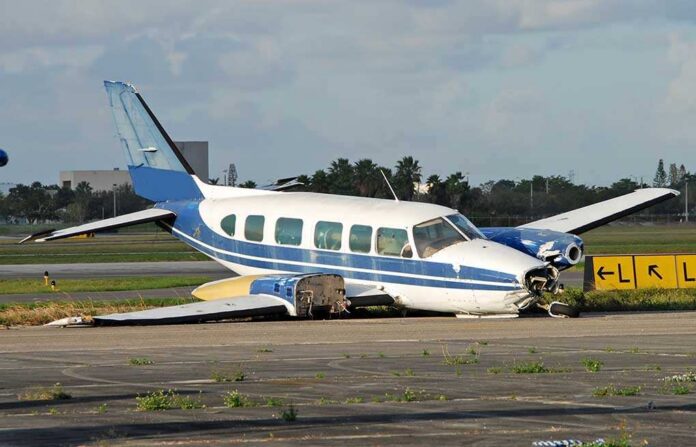
Survivable forced landings are rarely tidy; they are the product of a power loss, a pilot’s energy management under stress, and—sometimes—terrain that forgives. In eastern North Carolina, a Piper PA-32 carrying a pilot, his wife, and two dogs met trees instead of open earth and everyone walked away. That outcome is not luck alone; it is a recognizable pattern in general aviation emergencies and a case study in how airplanes and airmanship turn a bad day into a survivable one.
At a Glance
- A Piper PA-32 en route from Hickory to Ocean Isle Beach lost engine power and descended into trees; all occupants survived with minor injuries.
- The pilot reported the engine was not producing power; the FAA noted mechanical issues and opened an investigation with the NTSB.
- Tree contact—rather than hard terrain—dissipated energy and likely reduced impact forces dramatically.
- Power-loss events are a leading accident category in general aviation; “engine failure” spans multiple root causes, from component breakage to fuel issues.
What happened: a forced landing that stayed controllable
Local outlets identified the airplane as a single-engine Piper PA-32 that departed Hickory Regional Airport bound for Ocean Isle Beach with pilot Dustin Davis, his wife Autumn, and their dogs aboard. En route over eastern North Carolina, the pilot reported a loss of engine power, maneuvered to maintain control and airspeed, and ultimately contacted treetops, which arrested the descent before a direct ground strike. Both adults were evaluated for minor injuries; the dogs were unhurt. The couple’s account, paired with on-the-record statements about mechanical trouble and ongoing federal investigation, forms a consistent factual spine across the coverage.
In Davis’s words, “The engine just wasn’t producing power.” That phrase matters because it describes the effect—insufficient thrust to sustain flight—without claiming a specific cause. The FAA confirmed the aircraft experienced mechanical issues before the collision with trees and, with the NTSB, commenced the standard post-accident process. At this stage, what is clear is the sequence: power loss, glide, obstacle clearance, then a tree impact that left the aircraft suspended close to the ground—an outcome multiple survivors of similar events have credited with lowering deceleration loads to survivable levels.
Why trees can save lives: the physics of a “soft” crash
Airplanes are designed to be controlled without power, and pilots train to convert altitude into airspeed and time—time to pick a landing area, configure the airframe, and arrive at the slowest controllable speed. When open fields or runways are absent, forest canopies sometimes function as a crushable, energy-absorbing medium. Branches fail progressively, extending the deceleration distance compared with a sudden stop on compacted soil or pavement. Reports in this case describe the airplane striking smaller trees before coming to rest near the ground; that sequence is consistent with significant energy dissipation prior to cabin intrusion, which aligns with the minor injury outcome reported by responders.
The PA-32’s robust cabin structure and shoulder harnesses—standard safety equipment in many examples—further reduce injury risk in low-to-moderate deceleration crashes. While each accident geometry is unique, survivability rises sharply when impact forces remain within the biomechanical tolerance of belted occupants and when cabin volume stays intact long enough for egress. Here, occupants exited and were evaluated on scene, a result that fits the tree-cushioned, low-altitude stop described in the coverage.
What “engine failure” does and does not explain
In public shorthand, “the engine failed” carries an intuitive clarity that investigators do not share. Power loss is an outcome; causes range from broken engine components to fuel exhaustion, fuel starvation, induction or carburetor icing, contaminated fuel, ignition faults, or mis-rigged controls. FAA and NTSB analyses place powerplant-related failures among the leading contributors to general aviation accidents, but they also caution that fuel-related events are frequently interwoven or misclassified. In other words, identical cockpit symptoms—silence from the propeller—mask divergent root causes that demand different prevention strategies.
This is why accident work products are staged: a preliminary report to fix facts—who, what, where, when—followed by factual reports on the engine, airframe, and operations, and only then a probable cause. The current reporting is appropriately conservative: it establishes power loss and mechanical trouble without asserting a final mechanism. For readers trying to learn from the event today, the actionable takeaway is not the missing root-cause label but the reliable sequence that follows power loss: pitch for best glide, manage configuration, pick a landing area, and fly the aircraft to the end.
How we got here: recurring patterns in GA power-loss accidents
Across two decades of data, the FAA—working with the General Aviation Joint Safety Committee—has consistently listed system/component failure of the powerplant among the top causal categories in fatal GA accidents, alongside loss of control in flight and controlled flight into terrain. The category’s persistence is not evidence of stagnation; it reflects the broad universe of small-aircraft engines, operating environments, maintenance regimes, and pilot decision chains. Importantly, the data also show that training and operational discipline—fuel planning, preflight verification, engine health monitoring, and immediate memory actions on power loss—materially shift outcomes toward survivability when failure does occur.
Power loss after takeoff remains the most unforgiving scenario, with low altitude leaving little time to trade height for airspeed or to turn toward alternate landing sites. En route failures, by contrast, give pilots more geometry to work with; altitude is time, and time enables option generation. The North Carolina flight was cruising when trouble started, affording the pilot minutes—by his account—to configure and steer toward the least-worst terrain. That temporal buffer, combined with the decelerative properties of trees, sets the stage for what followed: a cabin you can step out of.
Terminology, checklists, and the disciplined response
Three phrases often get blurred in public retellings: forced landing, emergency landing, and crash landing. A forced landing is compelled by mechanical or environmental necessity; an emergency landing is any landing made under urgent conditions; a crash landing is an impact that damages the aircraft and often occurs off-runway. One event can be all three. The decisive difference is control. Pilots train to preserve it by immediately pitching for best glide speed, selecting mixture, fuel, and ignition settings that might restore power, configuring flaps and gear for the chosen touchdown area, and securing the cabin. Even when power cannot be recovered, adhering to this sequence keeps the wing flying and impact energy as low as conditions allow—precisely the dynamic readers see in the North Carolina case.
There is also a human factor: cognitive tunneling under stress can narrow attention prematurely on a single hypothesis (“the engine quit”) rather than the checklist’s branching logic. Habit patterns built in training—spoken flows backed by printed lists—counter that compression. When survivors later describe the event as a blur followed by one or two decisive moves, they are often recalling a well-rehearsed algorithm executed under pressure.
Pilot, wife and dogs survive dramatic tree-top crash landing after plane suffers engine failure: 'Just pray' https://t.co/hHmo9uw5f7 pic.twitter.com/fQa3RfBwBw
— New York Post (@nypost) October 23, 2026
What this means for pilots and passengers
For pilots, the lesson is clear: treat altitude as a savings account, rehearse the power-loss flow until it is reflexive, and brief passengers on restraints and egress even on “routine” hops. For aircraft owners, engine health monitoring, rigorous fuel management, and timely compliance with service bulletins buy down the likelihood that a power-loss scenario arises at all. For passengers, two practical points travel well: wear the shoulder harness snug, and stow heavy items low and secure—both shape survivability when deceleration loads arrive.
Sources:
nypost.com, article.wn.com, m.dailyadvent.com, faa.gov, faasafety.gov
© conservativefreepress.com 2026. All rights reserved.