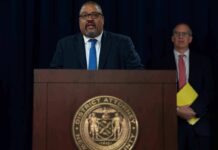
The egg attack on Albin Kurti was not a sideshow; it was the visible rupture of a parliament already trapped in a constitutional squeeze, where no bloc could govern alone and every procedural delay carried the risk of another election.
Key Points
- An opposition lawmaker threw eggs at acting Prime Minister Albin Kurti during a tense parliamentary session in Pristina.
- The confrontation came after Kurti asked lawmakers for more time to negotiate before naming a parliamentary speaker.
- The immediate dispute sits inside a deeper deadlock over coalition math, parliamentary leadership, and presidential انتخاب? no—over the presidency and the shape of a governing majority.
- Kosovo’s chamber has a history of theatrical disruption when political bargaining breaks down, and this episode fits that pattern closely.
What Happened in Parliament
Kurti was struck by eggs on the floor of the Kosovo Assembly after telling lawmakers he needed more time to continue negotiations with other parties before proposing a candidate for speaker. Reporting from BBC, Deutsche Welle, Al Jazeera, and other outlets identified the lawmaker as Time Kadrijaj of the Alliance for the Future of Kosovo and described lawmakers and police intervening as the chamber descended into chaos. The session was suspended after the confrontation.
The episode was dramatic, but its mechanics were plain: Kadrijaj treated the chamber itself as the stage for opposition, using a physical gesture to reject Kurti’s request for delay. Kurti, for his part, framed the delay as an attempt to avoid a fresh dissolution of the political process. He said there was still no political agreement and asked for additional time so he could present the speaker’s name. That detail matters, because it shows the clash was not random anger; it was a dispute over who controls the timetable of government formation.
The Deadlock Behind the Eggs
Kosovo’s post-election arithmetic has been unforgiving. Kurti’s Vetëvendosje emerged first in the snap election but did not win a governing majority, leaving him dependent on smaller parties and coalition bargaining to build a workable assembly. Contemporary reporting said talks with the Democratic League of Kosovo remained stuck, with the presidency among the central bargaining points. In other words, the fight over a speaker was only the visible layer of a wider contest over institutional power.
This is the core reason the incident resonated so strongly. In systems where no party can govern alone, parliamentary procedure becomes a proxy battlefield. Speaker selection, presidential nominations, and deadlines for constituting the assembly are not merely administrative steps; they are leverage points. If negotiations fail, the consequence is not just embarrassment in the chamber. It can be institutional paralysis, repeated suspension of sessions, and the constant threat of returning to the electorate without resolving the underlying coalition problem.
Why Kosovo’s Parliament Keeps Turning Into a Pressure Valve
Kosovo has lived through this pattern before. Reuters reported earlier parliamentary egg-throwing over a deal with Serbia, and Al Jazeera documented opposition lawmakers releasing tear gas into the chamber in 2015 during a separate constitutional crisis. That history gives the Kurti episode a sharper meaning: in Kosovo, disruptive tactics are not an isolated novelty but part of a recurring repertoire when political actors believe ordinary parliamentary bargaining is failing.
The point is not that eggs decide policy. The point is that spectacle becomes a weapon when institutions are under strain. Throwing eggs does two things at once: it physically interrupts proceedings and symbolically declares that the speaker, or the government formation process behind the speaker, lacks legitimacy. That is why these scenes travel so quickly across media. They compress a dense constitutional conflict into one image that ordinary readers can grasp at once.
Kurti’s Calculation: Delay as Strategy, Not Evasion
Kurti’s position, as reflected in multiple reports, was that additional time was necessary to reach a broader agreement and avoid another election. That is a defensible political strategy in a fractured parliament. When a party lacks the numbers to impose a settlement, asking for time is often the only way to keep negotiations alive. It can also be a way to avoid a procedural dead end that hands opponents a chance to force a new vote before a coalition has been assembled.
Still, the strategy has an obvious weakness: delay is expensive. The longer talks drag on, the more opportunity rivals have to accuse the incumbent side of stalling, and the more the public sees paralysis instead of governance. That is the political pressure cooker in which Kadrijaj’s protest landed. The opposition was not simply objecting to Kurti’s manners; it was challenging the premise that waiting would produce agreement rather than prolong gridlock.
What the Episode Says About Kosovo’s Governing Problem
The most important lesson is structural. Kosovo’s recurring deadlocks show how fragile coalition democracies become when electoral plurality does not translate into legislative control. The winner can arrive first and still remain hostage to bargaining, and the loser can still block progress by exploiting procedural choke points. That is why leadership contests inside parliament matter so much: they are the hinge between election results and actual government.
In that sense, the egg attack was both crude and revealing. It exposed a political class operating in a space where the normal grammar of compromise has frayed enough that symbolic violence feels useful. It also showed Kurti choosing patience over confrontation, insisting that more time could still produce a governing agreement. Whether that patience succeeds depends on whether the parties involved can convert mutual leverage into a durable bargain — the unglamorous work that, in Kosovo, repeatedly proves harder than the dramatic moment on the chamber floor.
The Broader Consequence
For Kosovo, the real risk is not the embarrassment of a viral video. It is the normalization of paralysis. Every suspended session, every missed deadline, and every resort to spectacle makes the same point louder: the institutions are being asked to do more than the political system is willing to permit. If that gap is not closed, the country remains vulnerable to the same cycle — inconclusive elections, coalition haggling, chamber disruption, and renewed pressure for another vote.
That is why this episode belongs in the longer history of Kosovo’s parliamentary crises. The eggs were the headline image, but the governing problem is the one behind them: a democracy trying to turn fragmented electoral mandates into stable authority, and repeatedly discovering how difficult that conversion can be.
Sources:
facebook.com, youtube.com, dw.com, indiatoday.in, tuko.co.ke, independent.co.uk, aljazeera.com, reuters.com, instagram.com
© conservativefreepress.com 2026. All rights reserved.