
Intraparty flare‑ups like the protesters who interrupted Hakeem Jeffries are not evidence of a party breaking apart; they are the predictable stress test of congressional leadership’s real job—balancing activist demands for maximal accountability with the electoral and procedural constraints that govern what can actually pass, hold up in court, and protect vulnerable members in the next election.
At a Glance
- Protesters confronted House Democratic Leader Hakeem Jeffries over impeachment, climate, and foreign policy demands; the disruption is documented, the allegations are not independently substantiated beyond the activists’ claims.
- Jeffries has centered “affordability” as a governing message while resisting a Senate permitting package he says needs changes—an illustration of leadership threading policy substance and coalition management.
- Impeachment is a House‑controlled, high‑bar process whose utility is bounded by constitutional design, committee practice, and Senate supermajority requirements.
- Permitting reform is not monolithic: details on review timelines, litigation windows, transmission build‑out, and community safeguards determine whether a bill accelerates clean energy or dilutes environmental protections.
What was contested in the room—and what was actually on the table
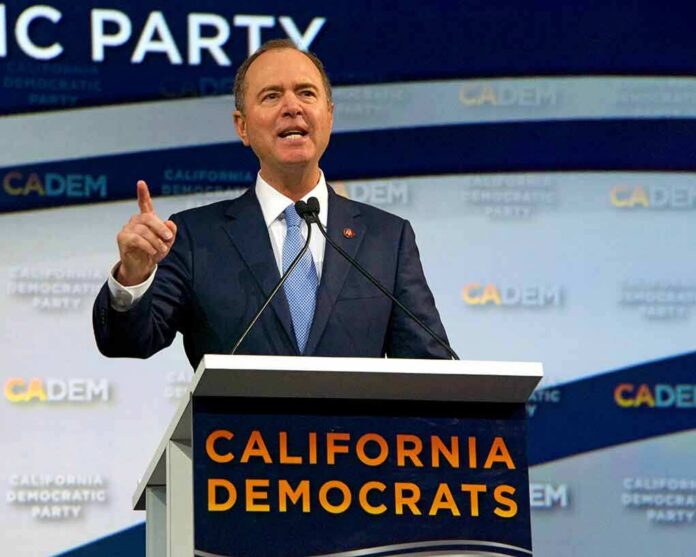
Video and wire services captured activists interrupting Jeffries at a Democratic conference, demanding impeachment, a Green New Deal, Medicare for All, an arms embargo on Israel, and a categorical blockade of a Senate permitting package branded the Bipartisan American Affordability and Jobs Act (BAAJA). Those recordings reliably establish the confrontation itself. They do not, on their own, prove the activists’ further claims about corporate influence or motives; those remain allegations absent corroboration. By contrast, there is documentary evidence for Jeffries’s stated governing lane: a sustained affordability message and publicly signaled reservations with the Senate permitting bill, which his office said “falls short in several areas,” a stance short of blanket opposition but equally short of a rubber stamp.
That juxtaposition—maximalist demands from the left and calibrated positioning from leadership—is not a muddle so much as the core reality of party management in a closely divided system. The question is how those choices are structured and why they persist.
Why impeachment chants collide with constitutional and strategic limits
Impeachment is not an on‑demand instrument. The Constitution vests the House with the sole power to initiate proceedings, typically via committee inquiry authorized by the majority; conviction requires two‑thirds of the Senate—an intentionally prohibitive threshold that transforms impeachment from a pressure‑valve into a high‑risk, high‑salience endeavor. Even when the House acts, outcomes turn on evidentiary development, institutional time, and cross‑chamber math. Leaders weigh not only merits but also opportunity costs: floor time displaced, investigative bandwidth, and the possibility of acquittal that can strengthen, rather than weaken, the target. That is not an argument against accountability; it is a recognition that Congress owns more tools than impeachment—subpoena power, public hearings, statutory tighteners, and appropriations riders among them.
Activists’ chants—“The American people demand impeachment”—are a form of advocacy, not a procedural key. Leadership’s reluctance to pledge impeachment on demand reflects both constitutional architecture and the basic electoral incentive to shield front‑liners from roll calls that will be litigated in swing districts long after the cameras leave.
Affordability as governing frame—and how permitting reform became the proxy fight
Jeffries has cast affordability as the party’s through‑line: lower costs, police fraud and price‑gouging, and keep policy trains moving on issues with broad resonance like prescription drugs and utility bills. The friction point is how to translate that banner into infrastructure that actually arrives on time and on budget. Enter permitting. Supporters of the Senate package argue that tightened deadlines, consolidated reviews, and more predictable litigation windows would unlock supply—transmission, generation, pipelines—and therefore relieve price pressure while enabling energy transition at scale.
Opponents warn that an undifferentiated “streamlining” can become a deregulatory backdoor: weaken environmental review, sideline frontline communities, and privilege fossil infrastructure that will outlive climate budgets. Jeffries’s position—press for changes rather than wholesale embrace—tracks this substantive split. His office’s on‑record view that the bill “falls short” signals leverage‑seeking: extract transmission‑first provisions, preserve meaningful National Environmental Policy Act (NEPA) review where warranted, and design judicial review windows that speed clean energy interconnection without immunizing poor projects. The price tag matters less than sequencing; the grid we build in the next decade determines both affordability and emissions profiles for the next forty.
How congressional leadership balances activists, moderates, and the calendar
Congressional research and practice point to a stable pattern: leaders shape the agenda to protect vulnerable members, preserve bargaining leverage with the other chamber, and reinforce the party brand that will be tested in the next election. That means limiting poison‑pill votes, centralizing negotiations on cross‑pressured bills, and keeping the message architecture—here, affordability—intact even as specific planks (permitting, drug pricing, antitrust) are bartered in committee and across chambers. The resulting optics can look like polarization or timidity when, in fact, they are a predictable byproduct of a coalition encompassing climate maximalists, labor moderates, and suburban pragmatists.
Social movement pressure is part of that ecosystem. It surfaces blind spots, forces public commitments, and occasionally resets what counts as the “moderate” position. But it does not nullify sequencing constraints or vote counts. Leaders who appear to temporize are often husbanding scarce floor time and bargaining chips for vehicles that can move; that is especially true when the Senate’s filibuster or a veto threat looms, or when a two‑thirds Senate bar makes impeachment a communicative act more than a sanction.
Parsing the protesters’ policy checklist
Three demands deserve clear translation. First, a Green New Deal is a framework, not a single bill; its elements—clean electricity standards, large‑scale transmission, workforce and industrial policy—play out across tax, appropriations, and permitting statutes, which is why permitting has become the unexpected hinge for the climate coalition. Second, Medicare for All implies wholesale replacement of private coverage with a national plan; even within the Democratic caucus, that is a minority position, and leaders tend to advance incremental cost‑down measures that fit the affordability frame and can survive a Senate parliamentarian ruling. Third, an arms embargo on Israel is foreign policy with acute executive‑branch equities; House leaders can force votes and signal priorities, but durable policy change here typically requires cross‑committee alignment and White House concurrence.
None of this diminishes the moral force of advocacy. It situates it within the institutional mechanics that convert demands into text, hearings, and ultimately statutory law that courts will sustain.
Liar!” “Traitor!” — and it wasn’t Republicans shouting.
Why did progressive protesters shout down Hakeem Jeffries in Denver, just days before he’s expected to claim the Speaker’s gavel?Follow @realShadowDossier — the stories they hope you skim past.
— Jecob BIOCLANDESTINE (@clandestine45) November 16, 2026
The durable lesson: substance lives in the details—and in the vote math
The Denver disruption will not be the last, because the underlying tensions are structural. Impeachment remains a blunt instrument bounded by constitutional design. Affordability is a viable north star only if the build‑out that lowers costs also accelerates decarbonization, which lives or dies on permitting architecture and transmission finance. And leadership’s job is to translate movement energy into bankable votes without detonating the coalition needed to govern after the next election. Evaluating Jeffries—or any leader—therefore requires looking past the viral clip to the two places that matter most: the legislative language they are willing to accept or reject, and the roll calls they schedule or avoid. On those, there is a record to read—and to hold to account.
Sources:
thehill.com, savingplaces.org, observertoday.com, washingtonsun.com, news.meaww.com, newrepublic.com, whec.com, apnews.com, congress.gov, constitution.congress.gov, politifact.com, marubeni.com
© conservativefreepress.com 2026. All rights reserved.