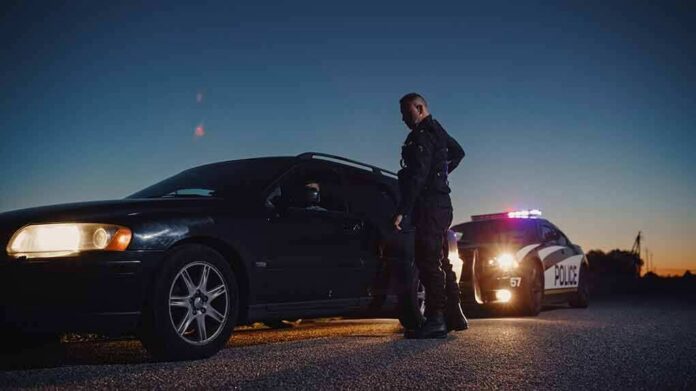
Police officers across the country really do touch the back of cars during traffic stops, and the habit traces back to a decades-old officer safety trick involving fingerprints.
Quick Take
- Officers commonly tap or touch a car’s taillight or trunk before approaching the driver’s window.
- A police union leader confirmed the practice is meant to leave fingerprints as proof an officer was at the scene.
- The touch also lets officers check if the trunk is closed and look for hidden dangers.
- At least one retired officer says the fingerprint claim has never been formally proven with actual evidence.
- The habit dates back before dash cams and body cameras became standard police equipment.
A Small Gesture With a Real Purpose
Drivers pulled over for speeding or a broken headlight often notice something odd. Before the officer even reaches the window, a hand touches the trunk or taillight. This isn’t random. Police officers around the country have described it for years as a habit built for safety, not small talk.
William Johnson, who leads the National Association of Police Organizations, told fact-checkers that officers do touch taillights and other parts of a car’s rear on purpose. He said the goal is simple: leave a fingerprint that proves an officer was physically at that vehicle if something goes wrong later.
Why Fingerprints Still Matter
Nick Fresolone, a retired instructor at the New Jersey State Police Academy, explained the reasoning in plain terms. If a stop turns violent or a driver flees, investigators can check the taillight glass for a print. That print becomes proof the officer made contact with the car before anything happened. The idea started long before body cameras existed, when officers had few other ways to document a stop.
The gesture does more than protect officers legally. Safety experts note that traffic stops carry real risk, since officers cannot always see what’s happening inside a vehicle or trunk before they approach. Training materials on officer safety describe the early moments of a stop as one of the most dangerous parts of the job, requiring quick decisions and constant awareness of surroundings.
Checking the Trunk, Not Just Leaving a Mark
Beyond fingerprints, officers say the touch serves a second job: checking that the trunk is shut tight. A loose or open trunk could hide a weapon, a hidden person, or another threat the officer can’t see from the front. Touching it firmly confirms it’s secure before the officer walks closer to the driver’s door, cutting down on surprises during an already tense moment.
Some explanations also point to tampering checks. Officers may press on the taillight or bumper to feel for looseness, damage, or signs the vehicle was altered. This fits with the traffic-stop paperwork many officers must file, which can include notes about the vehicle’s condition at the time of the stop, not just the driver’s paperwork.
Not Every Officer Agrees on the Fingerprint Story
The story isn’t accepted by everyone who has worn a badge. One retired officer pushed back hard in a video, saying he has never seen proof that any agency has actually pulled a fingerprint off a taillight and used it to identify an officer at a scene. He argued the safety and trunk-check reasons hold up, but the fingerprint explanation may be more folklore passed between officers than a documented forensic method.
That disagreement doesn’t erase the fact that officers really do touch cars this way. What’s less settled is why every department teaches it, or whether it’s simply been handed down from veteran officers to rookies over the decades. Either way, the habit shows how small routines in policing can carry big explanations that outlast hard proof.
What Drivers Should Take From This
For most drivers, the touch is harmless and quick, part of the normal rhythm of a traffic stop. It reflects officers trying to protect themselves and gather information before a face-to-face conversation begins. Understanding the reasoning behind it, whether fingerprint evidence, trunk safety, or tampering checks, can make an otherwise unsettling moment feel a little less mysterious.
Sources:
carparts.com, threebrosauto.com, encyclopedia.com, youtube.com
© conservativefreepress.com 2026. All rights reserved.