
What looks like an unprecedented papal gesture is, in the machinery of U.S. election law, a straightforward act: a U.S. citizen living abroad requested, received, and submitted an absentee ballot—status and job title notwithstanding.
The Short Version
- Pope Leo XIV submitted a U.S. mail-in ballot from abroad; the Holy See framed it as an ordinary exercise of his rights as an American citizen.
- Reporting traced his registration to Illinois and an absentee ballot request through the Will County clerk.
- Federal law provides a well-worn process for U.S. citizens overseas—civilian or government employee—to vote absentee in federal elections.
- The legal framework is built around citizenship and voting residence, not occupation; being a foreign head of state is symbolically unusual but not a listed disqualifier.
What Happened, In Plain Terms
The Vatican publicly stated that Pope Leo XIV—an American-born cleric who now leads the Catholic Church and is head of state of the Holy See—cast a U.S. absentee ballot, continuing what it described as his long-standing civic participation whenever eligible. The Holy See’s press office was explicit: he exercised his right to vote as a U.S. citizen and submitted a mail-in ballot in Chicago. Contemporaneous U.S. reporting identified him on the rolls in Illinois and noted an absentee request routed through the Will County clerk earlier that month. In election-administration terms, those are the operative facts.
Media descriptions of “first pope to vote in a U.S. election” captured the novelty. The category that mattered to election officials, however, is not “pope”; it is “U.S. citizen residing abroad who maintains a voting residence in a U.S. jurisdiction.” The Uniformed and Overseas Citizens Absentee Voting Act (UOCAVA) and the systems built around it are designed to accommodate precisely that sort of voter.
The Legal Mechanism: Citizenship and Voting Residence, Not Job Title
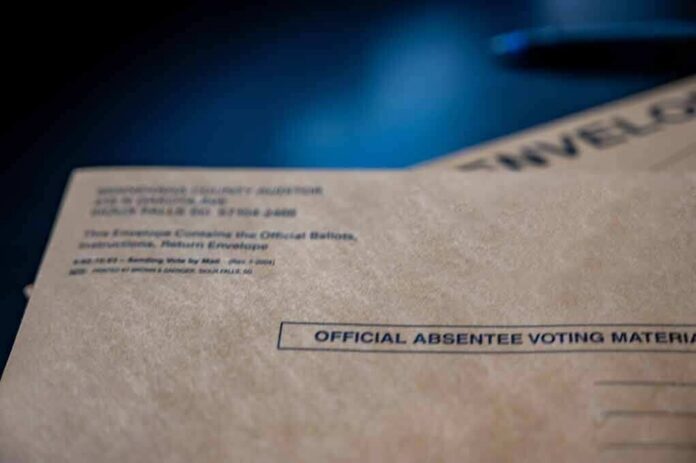
American election administration is federated, but the absentee infrastructure for citizens overseas follows a consistent logic. UOCAVA provides a federal framework for absentee voting in federal contests (president, Senate, and House) by U.S. citizens outside the country, alongside service members and eligible family members. The Federal Voting Assistance Program (FVAP), a Department of Defense office, operationalizes that framework with standardized forms, timelines, and state-specific instruction, and the State Department augments assistance for civilians abroad.
Mechanics are prosaic. A citizen abroad defines or confirms a “voting residence” back home—a specific address that determines ballot style—registers if needed, requests a ballot (often via the Federal Post Card Application), and returns it by the state’s permitted method and deadline. The test embedded in UOCAVA guidance is elemental: U.S. citizenship, age eligibility, a bona fide voting residence for ballot assignment, timely application, and proper return. It does not ask for occupation, employer, or whether the citizen holds public office in another country.
How This Applied Here
According to the Vatican’s statement, Leo voted by mail “in keeping with this long-standing practice of civic participation”. U.S. coverage anchored the administrative specifics in Illinois: the registration was tied to a New Lenox address, and an absentee ballot was requested from the Will County clerk on October 3. AP’s legal summary, published by PBS, underscored the controlling point: U.S. federal law allows citizens living abroad, including those working for foreign governments, to vote via absentee ballot. That articulation maps directly onto FVAP’s own guidance: most U.S. citizens abroad can vote absentee by following the standardized process.
This is not a loophole crafted for the obscure. Millions of Americans live overseas at any given time; the absentee apparatus is designed for scale and neutrality. In that design, neutrality means the law does not calibrate rights up or down based on the sensitivity of one’s employment. By intent, a schoolteacher on contract in Lima, an oil engineer in Doha, and an American who serves in a foreign cabinet all move through the same absentee gateway if they remain U.S. citizens with a U.S. voting residence.
Why the Symbolism Feels Bigger Than the Law
Two roles collide in the public imagination: the pope as a universal pastor above partisanship, and a private citizen with an American passport engaging in ordinary civic practice. That collision is aesthetic and pastoral before it is legal. Commentators within the Church world have voiced prudential concerns that a papal vote might nationalize the papal office or erode the Holy See’s posture of political neutrality, even if the ballot is secret and the act is personal rather than institutional. But the American system does not condition the franchise on how an act will be perceived by foreign or domestic audiences. It conditions it on legal status and procedural compliance. The Vatican’s statement, pointedly phrased around rights and duties of citizenship, leaned into that distinction.
Historical comparisons are thin because popes have not typically held U.S. citizenship. Prior pontiffs who were technically eligible to vote in their home countries largely chose not to, as a matter of prudence rather than prohibition. Leo’s case adds a distinct variable—a sitting foreign sovereign who is also a U.S. citizen—but it does not introduce a new clause into American election law. The governing framework still asks: Is he a U.S. citizen? Does he have a qualifying voting residence in a state? Did he follow the absentee process? On available reporting, yes.
The Administrative Backbone: How Officials Think About It
Election officials tasked with processing overseas ballots rely on uniform forms, signature verification, and state-by-state rules on receipt deadlines and return methods. The FVAP Voting Assistance Guide distills each state’s requirements; Illinois, like other states, accommodates UOCAVA voters who maintain a voting residence in the state but reside abroad. None of this turns on the sensitive question “should a foreign head of state vote?” because that is not a legal category election offices adjudicate. Their charge is narrower and clearer: apply law and procedure consistently to similarly situated citizens.
AP’s reporting added one adjacent point some readers conflate with voting: the State Department may review the citizenship status of Americans who serve as foreign heads of state or senior ministers, given potential questions under nationality law about allegiance and expatriating acts. That review—if undertaken—concerns retention of citizenship, not the mechanics of absentee voting for those who remain citizens on the rolls.
What It Means Going Forward
The system is built to be status-blind. That principle yields predictable administration: if you are a U.S. citizen abroad with a voting residence and you meet the deadlines, you can vote in federal elections, whether you are a relief worker, an academic, or a prime minister serving another sovereign. The symbolism of certain jobs will always invite broader debate; the law’s virtue here is its indifference to symbolism. That indifference is not a bug. It is how citizenship-based rights hold steady across uncommon biographies.
Sources:
zerohedge.com, sun-sentinel.com, pbs.org, thehill.com, jonathanturley.org, phuulishfellow.wordpress.com, apnews.com, bbc.com, firstpost.com, cnn.com, aol.co.uk, fvap.gov
© conservativefreepress.com 2026. All rights reserved.