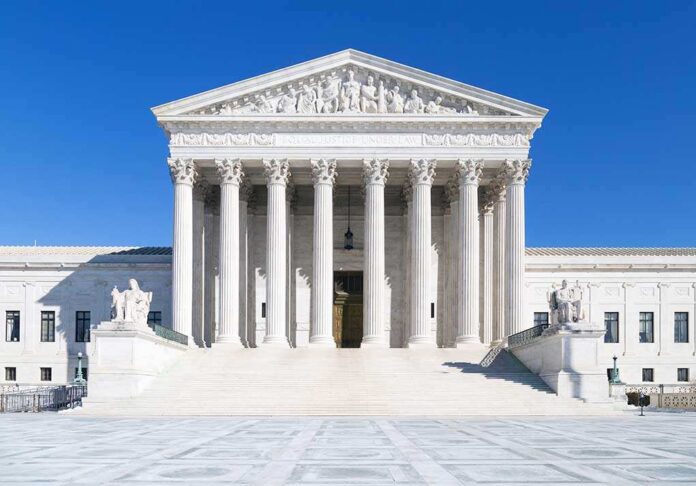
The Supreme Court just granted certiorari in a pivotal case that could slam the door on radical leftist climate lawsuits threatening America’s energy independence under President Trump’s pro-energy agenda.
Story Highlights
- U.S. Supreme Court agrees to hear oil companies’ appeal against Boulder, Colorado’s 2018 climate tort lawsuit on February 23, 2026.
- Trump administration backs defendants, arguing federal preemption under the Clean Air Act protects interstate energy production from state overreach.
- Case expands to jurisdiction questions, potentially ending dozens of similar suits nationwide and shielding the oil sector from billions in liability.
- Unlike prior denials in Honolulu and Minnesota cases, this grant signals justices’ scrutiny of local governments weaponizing courts against fossil fuels.
- Ruling could reinforce federal authority, aligning with conservative principles of limited government and national energy policy.
Case Origins and Boulder’s Bold Claim
Boulder City and Boulder County filed suit in 2018 against ExxonMobil and Suncor Energy in state court. They alleged the companies violated Colorado law through global emissions causing local extreme heat, wildfires, drought, and ozone issues. The localities seek billions in damages for mitigation costs like infrastructure upgrades and emergency responses. Lower courts denied dismissal motions, viewing the claims as state-law torts outside federal preemption. This approach mirrors nearly 60 similar suits since 2017 by Democrat-led localities targeting oil majors for climate harms while accusing them of deceiving the public on risks.
Colorado Courts Reject Preemption, Prompting SCOTUS Appeal
In May 2025, the Colorado Supreme Court upheld lower rulings, denying dismissal. It reasoned the Clean Air Act, which regulates interstate emissions federally, permits states supplemental authority over out-of-state sources for local impacts. Oil companies petitioned the U.S. Supreme Court in late 2025. Boulder initially waived opposition but filed a brief raising jurisdictional issues, prompting the Court to add a question on statutory and Article III jurisdiction alongside federal preemption of state greenhouse gas claims. The Trump Department of Justice supports the defendants, emphasizing protection of national energy production.
Supreme Court Grants Review Amid National Litigation Wave
On February 23, 2026, the Supreme Court granted certiorari in Suncor Energy (U.S.A.) Inc. v. County Commissioners of Boulder County. At least four justices approved, halting the case pending merits briefing and oral arguments, likely next term. This differs from prior denials in Honolulu and Minnesota cases. It parallels Chevron v. Plaquemines Parish, with a decision pending by June 2026. Oil firms celebrate it as a blow to disastrous state control disrupting federal regulation. The ruling could reshape climate tort litigation.
Implications for Energy Sector and Federalism
A win for oil companies would preempt state suits under the Clean Air Act and Constitution, potentially ending most of the 60-plus cases and shifting venue to federal courts. This shields the energy industry from massive liabilities, bolstering production critical to American jobs and independence. Localities like Boulder would lose hoped-for damages, forcing communities to bear adaptation costs without targeting out-of-state firms. Politically, it strengthens federalism, curbing local overreach aligned against President Trump’s industry-friendly policies and common-sense limits on litigation abuse.
Sources:
Supreme Court says it will take up climate change law challenge out of Colorado
US rules: Supreme Court to hear Colorado oil climate lawsuit
Climate Change Goes Back to the Supreme Court: Colorado Edition
Justices Will Mull Future Of State Climate Torts