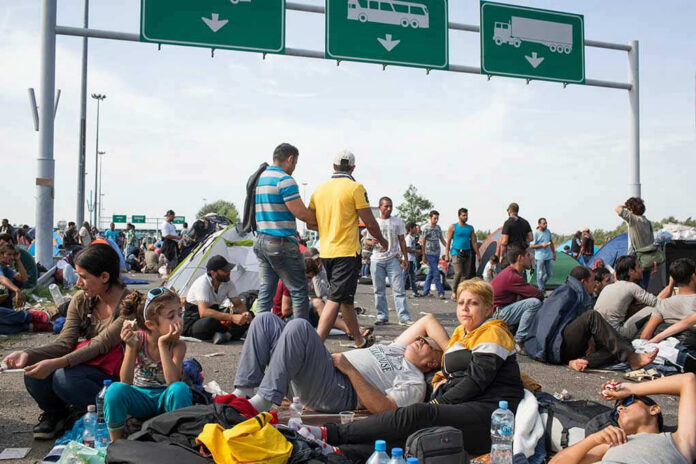
When a well-connected Washington foreign policy hawk says America should “prepare to welcome large numbers of Jewish refugees,” he is not just talking about charity; he is signaling the kind of crisis he expects and the political order he wants to shape around it.
Story Snapshot
- Mark Dubowitz is a deeply wired national security operator, not a random talking head, so his refugee talk lands inside real policy circles.[3][4]
- His remark about Jewish refugees gets filtered through his record as a hardline Iran and Israel advocate, which colors how both critics and supporters hear it.[4][5]
- No publicly available transcript cleanly captures the exact refugee quote in full context, leaving partisans to fight over framing instead of facts.[1][5]
- The fight over his words exposes a bigger question: when do “warnings” about refugees serve genuine contingency planning, and when do they serve an interventionist agenda?
Who Mark Dubowitz Is And Why His Words Travel
Mark Dubowitz does not operate on the margins of American policy; he leads the Foundation for Defense of Democracies, a Washington think tank that markets itself as a nonpartisan policy institute and focuses on Iran, sanctions, and global threat networks.[4] Biographical profiles recount that he has advised multiple presidential administrations and testified before Congress and foreign legislatures, giving him direct access to lawmakers and staff who translate talking points into policy language.[3][4] That institutional role means that a line about “large numbers of Jewish refugees” is not just internet chatter; it becomes potential fuel for hearings, op-eds, and legislative proposals.
Dubowitz’s public identity blends three strands that matter here: he is a Jewish commentator whose own family story includes ancestors fleeing pogroms, he is an expert on Iran’s nuclear program and threat finance, and he is a repeat advocate for strong action to deter or punish hostile regimes.[2][5] His writing on antisemitism argues that modern anti-Zionist narratives often camouflage old hatred of Jews, which, in his view, justifies aggressive political responses to protect Jewish communities. When someone with that worldview warns about future Jewish refugees, he speaks from a lens of historical persecution and contemporary strategic anxiety rather than neutral demography.
What We Know And Do Not Know About The Refugee Remark
The social media clips that sparked this debate highlight a quote attributed to Dubowitz: “The US should be prepared to welcome large numbers of Jewish refugees.” Those posts come from accounts hostile to his broader agenda, but they point to a real pattern in his work: he often frames threats in anticipatory terms, urging policymakers to move before a crisis explodes. However, the available research set does not include the full video or transcript where he allegedly said this, so the scale, timing, and trigger conditions behind his warning remain undefined.[1][5] That evidentiary hole matters for anyone who cares about honest debate rather than meme warfare.
Without the underlying transcript, it is impossible to say whether Dubowitz presented this as a near-certainty, a remote contingency, or a rhetorical device meant to underscore rising antisemitism in Europe or the Middle East.[1][5] It is also unclear whether he linked the refugee idea to specific intelligence assessments or migration data, or whether he used it as one more brick in his long-standing argument that Western governments must treat anti-Israel coalitions as a strategic emergency.[4] For a policy-literate audience, that distinction is enormous: contingency planning is prudent governance, while exaggerated refugee talk without anchoring evidence starts to look like agenda-driven fearmongering.
How His Track Record Shapes The Interpretation
Critics look at Dubowitz’s career and see a man whose professional mission has been to tighten sanctions, isolate Tehran, and push Western governments toward more confrontational postures against Iran and its proxies.[4][5] His own organization touts his influence on sanctions design and his expertise on Iran’s nuclear and missile programs, which supports the view that he is a political combatant more than a detached analyst.[4] When such a figure raises the specter of Jewish refugees, skeptics reasonably ask whether the narrative is primarily about humanitarian planning or about building domestic support for tougher military and economic measures abroad. From a conservative common-sense standpoint, motives matter: Americans have seen “refugee” and “humanitarian” frames used before to sell interventions that later turned into open-ended commitments with little accountability.
Supporters, by contrast, emphasize that Dubowitz’s warnings often proved directionally accurate about the brutality of regimes like Iran’s and the vulnerability of dissident populations.[4] They argue that a refusal to plan for worst-case scenarios because they sound politically inconvenient is its own form of negligence, especially when Jewish communities worldwide again face open calls for violence. That view lines up with a conservative instinct to take ideologues at their word when they threaten genocide or expulsion, rather than trusting that international institutions will step in on time. The hard question is whether welcoming “large numbers of Jewish refugees” would mean prioritizing one group over others or simply acknowledging that Jews, like Christians and other minorities, are often the first to be targeted when order collapses.
Refugees, American Priorities, And The Missing Policy Details
American conservatives generally balance three principles on refugee questions: national security, cultural cohesion, and moral responsibility. A call to prepare for large numbers of refugees, Jewish or otherwise, demands clarity on each point. How many people are we talking about? From where? Under what vetting standards? Answering those questions requires numbers and criteria, not just televised concern. Without publicly documented follow-up from Dubowitz in the form of detailed policy proposals, this particular quote lives as a floating alarm rather than a concrete blueprint.[1][5]
"The US should be prepared to welcome large numbers of Jewish refugees."
Mark Dubowitz, head of the Foundation for Defense of Democracies, helped push America into the Iran War and championed the Gaza genocide.
Now he's advocating for America to take in 1.2m Jewish "refugees."… pic.twitter.com/4CL8vryV7Y
— Chris Menahan 🇺🇸 (@infolibnews) June 5, 2026
That ambiguity is why the debate around Dubowitz’s remark feels more like a proxy battle over his overall foreign policy posture than a genuine argument about refugee systems. The research record here is rich on his biography, his views on Iran, and his thinking about antisemitism, but thin on explicit, documented refugee planning.[4] Until the specific interview or speech surfaces in full, citizens who care about American sovereignty and about persecuted minorities have to apply a simple filter: treat any dramatic line about “large numbers of refugees” as a prompt to demand specifics. If a Washington insider wants to reshape immigration policy on the back of looming crises, he owes the public more than a soundbite.
Sources:
[1] Web – U.S. Must Prep to ‘Welcome Large Numbers of Jewish Refugees,’ Pro-War …
[2] Web – Mark Dubowitz – Greater Miami Jewish Federation
[3] YouTube – Mark Dubowitz on day 12 of the Iran conflict – i24 News
[4] Web – Mark Dubowitz – Wikipedia
[5] YouTube – Mark Dubowitz, CEO of the Foundation for Defense of Democracies
© conservativefreepress.com 2026. All rights reserved.