

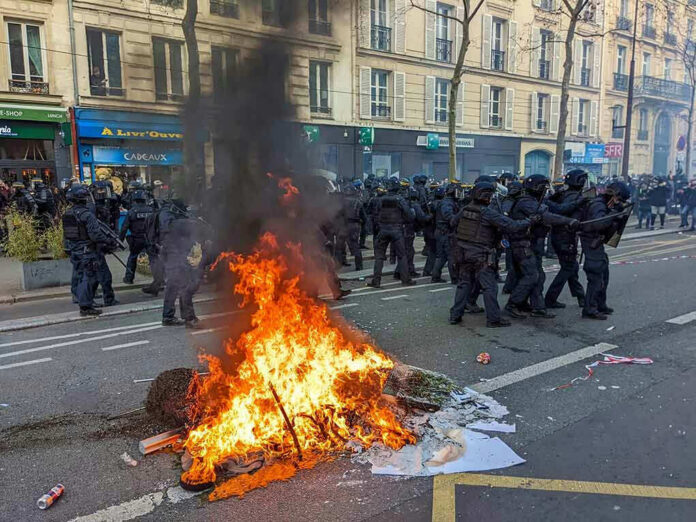
Simple monocausal stories about urban unrest are almost always wrong; France’s latest bout of violence fits a familiar, layered pattern where legitimate protest, opportunistic disorder, and long-standing socio-territorial fractures intersect—making sweeping claims that “immigration caused it” rhetorically potent but evidentially thin.
At a Glance
- President Trump publicly blamed France’s unrest on immigration and urged border closure; French leaders rejected that explanation and pointed to radical-left agitators and criminals.
- The disturbances were large and violent—arson, looting, attacks on civic buildings, and mass arrests—yet originated in student-led protests over schools, living costs, and public services.
- No official offender demographics or court data have surfaced confirming immigrants as principal perpetrators; authorities did not link the violence to immigrants.
- Research on French riots shows causal layering: local deprivation, segregation, youth concentration, policing flashpoints, and migration patterns interact rather than a single national cause.
What was asserted, and what the record shows
President Trump stated that “France is burning,” attributing the turmoil to immigration and urging European leaders to “close your borders and take control”. The timing coincided with a night of serious disorder—government buildings set ablaze, extensive looting, clashes with police, and roughly 1,800 arrests—providing ample imagery for a forceful explanatory claim. Yet French officials did not frame the violence as immigration-driven. President Emmanuel Macron distinguished large, peaceful demonstrations about living costs and public services from destructive actors; his government attributed the violence to radical-left groups and criminals rather than immigrants. That institutional framing directly contests Trump’s thesis.
The unrest’s origin story also undermines a categorical immigration explanation. Reporting describes an escalation that began with high-school protests over teacher shortages and poor facilities before broadening into cost-of-living and public-service grievances. Trump’s insistence that the events were “not about schools” contradicts those accounts and offers no supplemental mechanism—no offender dataset, organizational evidence, or court records—to bridge from rhetoric to causality.
Mechanism: how French urban unrest actually spreads
To understand why monocausal claims stumble, recall the architecture of French riots since 2005: an immediate trigger—often a policing incident or galvanizing event—cascades through suburbs marked by high youth concentration, economic deprivation, stigmatized housing estates (cités), and weak institutional trust. Migration and segregation are part of the topography, but not the whole map. Peer-reviewed analyses of the 2005 unrest and subsequent episodes identify socio-territorial factors—youth share, unemployment, illiteracy, spatial segregation—as robust correlates of where violence appears and spreads. Some work does find that higher immigrant shares are associated with a higher likelihood of minor unrest; one municipal-level study reports about 30% higher odds for minor disturbances with a one-standard-deviation increase in immigrant share (OR ~1.30). But those associations operate alongside, and often through, local deprivation and policing dynamics—not as a single master cause.
This layered model matters for policy. If the mechanism is cumulative stress—overcrowded schools, weak services, a brittle police-community interface—then focusing solely on border controls addresses, at best, a distal factor. It leaves untouched the conduits through which protests turn into vandalism or arson: anonymity in the urban form, opportunistic looting, and mobilization by fringe groups that “piggyback” on legitimate marches—precisely the pattern French officials alleged here.
Competing diagnoses: weighing the claims
Trump’s position is explicit and repeated: the violence is immigration-driven and demands border closure. The evidentiary base, however, is predominantly rhetorical and observational—images of diverse crowds, foreign flags, and urban fires—rather than derived from arrest demographics, court dockets, or intelligence attributions. In contrast, the French government’s account is named and specific: radical-left elements and criminals exploited otherwise legitimate demonstrations about the cost of living and public services. Independent reports echo the protests’ socioeconomic origins and do not present verified demographic data implicating immigrants as the primary actors. On the scale of specificity and testability, the institutional explanation is stronger.
This does not absolve the integration question. Research does connect immigrant concentration and segregated peripheries to the geography of unrest in France, including in 2005 and 2023, though the link is mediated by deprivation, schooling, and policing rather than identity alone. The common mistake is to jump from “association at place level” to “cause by group identity.” Without offender-level evidence, that leap is unsupported—and in France’s case, repeatedly contradicted by official briefings during this episode.
What data would resolve the dispute
Two datasets would move this debate from assertion to adjudication. First, an incident-level roster of arrests and charges—nationality, immigration status, age, place of residence, alleged offenses—tracked through case disposition. This distinguishes rumor from legal reality and prevents arrests from being misread as guilt. Second, a geospatial panel tying riot intensity to neighborhood indicators: recent immigration flows, unemployment, school quality, poverty, policing levels, and prior unrest. Pre-registered models could parse whether immigrant share predicts violence net of deprivation and youth concentration, and whether any effect is concentrated in minor versus major incidents—a distinction research already hints at.
Complementary evidence—authentic protest communiqués, organizers’ statements, verified social video with metadata, and any judicial findings on coordination by extremist networks—would clarify whether immigration, Islamism, far-left groups, or plain criminal opportunism supplied motive force. Until such records surface, sweeping national attributions—on either side—are more about politics than proof.
Policy implications that travel beyond a single weekend
France’s cycle should focus policymakers’ minds on the “plumbing” of cohesion: credible public services, especially schools; targeted investment in stigmatized neighborhoods; policing that is both firm and procedurally fair; and urban design that reduces opportunities for opportunistic violence. Border policy and integration strategy also matter—language acquisition, labor-market access, and anti-segregation measures shape whether migrant-heavy districts become springboards or pressure cookers. But border controls cannot backfill for failing schools or threadbare local institutions—and the evidence from past French episodes suggests the latter variables consistently carry weight.
For political leaders, the communication lesson is as practical as it is moral: separate condemnation of violence from acknowledgment of legitimate grievances. Macron’s formulation—support for lawful protest, zero tolerance for arson and looting—tracks that line and, crucially, preserves the policy space to improve services without rewarding destruction. Claims that collapse everything into “immigration” might rally a base but they obscure the operational levers that prevent the next spiral.
#Watch | France has imposed overnight curfews in parts of Paris on October 19 following violent protests, looting and clashes with police over the rising cost of living. Restrictions have also been introduced for minors in several French cities.
Meanwhile, U.S. President Donald… pic.twitter.com/j9XbkFpuh4
— The Hindu (@the_hindu) October 20, 2026
Bottom line
The French unrest was real, dangerous, and exploited by bad actors. It also began with schools, prices, and public services. Immigration and segregation sit in the background of many French riots, but the most defensible reading of this episode—based on named officials, contemporaneous reporting, and the comparative research record—is layered causation, not a single key. If leaders want fewer burning nights, they should govern to the layers, not the slogans.
Sources:
youtube.com, aol.co.uk, timesofisrael.com, democracynow.org
© conservativefreepress.com 2026. All rights reserved.