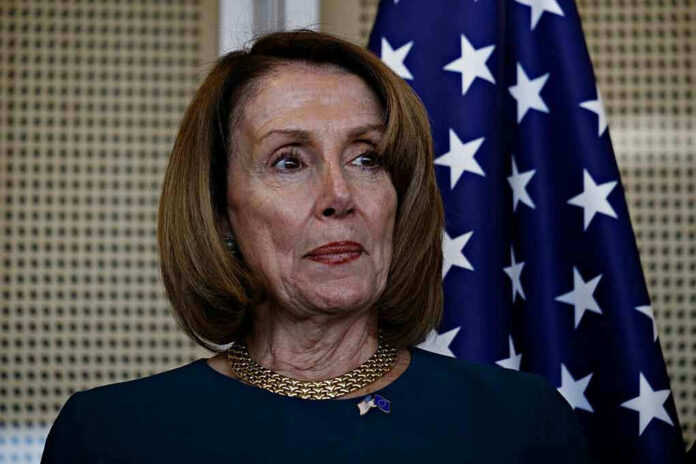
Former House Speaker Nancy Pelosi became visibly flustered on CNN when confronted about President Trump’s State of the Union accusations that she profited from insider trading, refusing to address his comments directly while claiming she supports stock trading bans for Congress.
Story Snapshot
- Trump called out Pelosi by name during his State of the Union address on February 24, 2026, demanding Congress pass the “Stop Insider Trading Act”
- Pelosi erupted on CNN hours later when Jake Tapper attempted to read Trump’s allegations, asking “Why do you have to read that?”
- Her husband Paul Pelosi traded up to $5 million in semiconductor stocks days before Congress voted on a $52 million industry subsidy in 2022
- Senator Josh Hawley’s “Honest Act” restricting congressional stock trading passed committee with bipartisan support the same day as Trump’s speech
Trump Targets Pelosi on National Stage
President Trump used his February 24, 2026 State of the Union address to call for passage of the “Stop Insider Trading Act,” directly challenging Nancy Pelosi’s stock trading record in front of a national audience. Trump questioned whether Pelosi would “stand up” for the legislation, noting he “wasn’t sure if anybody even on this side was going to applaud for that.” The pointed accusation transforms a policy debate into a personal indictment, leveraging America’s most-watched political speech to highlight questions about how lawmakers accumulate wealth while earning government salaries. This direct confrontation demonstrates Trump’s willingness to spotlight what many Americans see as a fundamental breach of public trust.
Defensive Response Raises More Questions
Hours after Trump’s speech, Pelosi appeared on CNN’s “The Lead” with Jake Tapper and displayed visible agitation when the host attempted to read Trump’s comments. She interrupted Tapper asking “Why do you have to read that?” before dismissing the allegations as “ridiculous.” Pelosi insisted she supports congressional trading bans “because of the confidence it instills in the American people,” yet deflected personal accountability by claiming “I’m not into it. My husband is, but it isn’t anything to do with anything insider.” Her attempt to redirect the conversation to Medicaid’s 60th anniversary suggests discomfort with scrutiny of her family’s investment practices. For conservatives who’ve watched Democrat elites escape accountability for years, Pelosi’s evasiveness confirms suspicions about double standards in Washington.
Pattern of Suspicious Trading Demands Accountability
The allegations against Pelosi aren’t baseless political attacks—they’re rooted in documented trading patterns that raise legitimate questions. In 2022, Paul Pelosi traded between $1 million and $5 million in semiconductor stocks mere days before Congress voted on a $52 million subsidy to that industry. Pelosi has accumulated hundreds of millions in wealth despite earning approximately $200,000 annually as a member of Congress. While she claims her husband’s investment success stems from “stock market acumen” rather than insider information, the timing of trades aligned with congressional votes strains credulity. Investigative reporting by Peter Schweizer in 2012 revealed extensive stock trading correlations that led to the STOCK Act, which Pelosi herself supported. That Democrats championed this legislation yet continued similar practices exposes hypocrisy that erodes public confidence in government.
Bipartisan Legislation Gains Momentum
Senator Josh Hawley’s “Honest Act,” originally introduced as the “PELOSI Act” in April 2025, passed through the Senate Homeland Security and Government Affairs Committee with bipartisan Democratic support on February 25, 2026. The bill expands beyond earlier versions to include restrictions on the president and vice president, addressing concerns that congressional trading bans alone would be insufficient. This legislative momentum suggests genuine cross-party recognition that lawmakers profiting from non-public information undermines democratic legitimacy. For Americans frustrated with government corruption, the bipartisan support offers hope that Congress might finally address conflicts of interest that have enriched politicians at taxpayers’ expense. However, whether Democrats will support legislation that applies to their own members remains the critical test of their commitment to ethics reform.
Nancy Pelosi Stammers and Dodges After CNN Presses Her About Trump's 'Insider Trading' Dig https://t.co/dPvDjMRRXf
— Twitchy Updates (@Twitchy_Updates) February 25, 2026
Trump’s focus on Pelosi highlights a credibility crisis Democrats face on ethics issues. Political analysts note Trump has “successfully called voters’ attention to what Democrats have been doing with less media coverage for years and years,” exposing how media bias shields Democrat misconduct from scrutiny Republicans routinely face. Pelosi’s defensive demeanor during the CNN interview, described by some observers as “panicking,” suggests the allegations carry political weight despite her denials. The absence of formal charges doesn’t negate the suspicious timing of trades or the fundamental question: how do public servants become extraordinarily wealthy while claiming to serve the public interest? For conservative voters who believe in limited government and accountability, Pelosi’s evasiveness reinforces the need for comprehensive ethics reform that applies equally to all members of Congress regardless of party affiliation.
Sources:
Nancy Pelosi erupts when asked by CNN’s Jake Tapper about allegations of insider trading – Fox News