
A business jet does not simply fall out of the sky over South Florida without a sequence of mechanical and atmospheric events conspiring against it in a matter of seconds — and the cockpit recordings from November 1 capture exactly that sequence, from routine turbulence management to a terminal, uncontrollable dive, in under two minutes.
Key Points
- A Learjet 60, tail number N722BD, crashed into a mobile-home neighborhood near Military Trail and 10th Avenue North in Palm Beach County around 12:50 p.m. on November 1, killing all nine people aboard.
- The aircraft had departed Austin-Bergstrom International Airport in Texas and was bound for North Eleuthera Airport in the Bahamas.
- Air traffic control audio documents a rapid, escalating descent — from roughly 10,000 feet per minute to more than 22,000 feet per minute with a 60-degree bank — before the aircraft struck the ground.
- The NTSB is leading the investigation with FAA support; the cause has not been determined, and formal findings typically take months to produce.
- The crash site sits roughly nine miles from Mar-a-Lago, within the densely populated residential corridor that defines much of inland Palm Beach County.
What Happened on the Ground
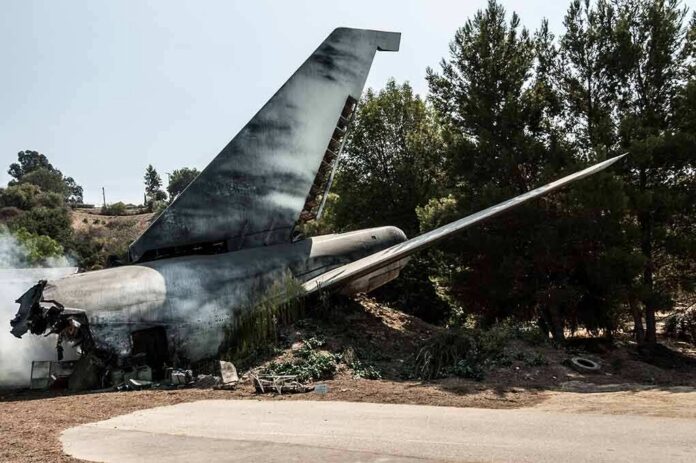
Shortly before 1 p.m. on a Sunday marked by stormy weather, the Learjet 60 went down in a mobile-home community near Greenacres, an area also referenced in various reports as Cresthaven or unincorporated Palm Beach County — the labeling varies, but every account describes the same impact site near Military Trail and 10th Avenue North. Witnesses and early video showed a large fireball, scattered debris, and extensive fire damage to the surrounding neighborhood. Florida Governor Ron DeSantis described the impact as resembling “a missile coming down,” a characterization consistent with the aircraft’s reported descent rate in its final seconds. Emergency crews closed Military Trail for several blocks and displaced roughly 600 residents from the adjacent mobile-home park as fire crews worked the scene and utility teams addressed downed power lines.
Transportation Secretary Sean Duffy confirmed on social media that all nine people aboard were killed, a toll consistent with every contemporaneous report. No official accounting of ground injuries or a complete property-damage tally had been released in the hours and days following the crash, though the visible destruction — a fireball, a blackened crater, and debris scattered across multiple properties — indicated substantial loss. The NTSB and FAA were jointly identified as the agencies responsible for the investigation, with the NTSB taking the lead role and committing to provide periodic updates as the inquiry progresses.
The Final Transmissions
Recorded air traffic control audio, identifying the aircraft by its call sign “November 722 Bravo Delta,” documents the sequence that preceded the crash in granular detail. The crew initially reported moderate turbulence, icing conditions, and an outside air temperature of negative 47 degrees Celsius while cruising near 35,000 feet — unremarkable numbers for a winter transit through a frontal system, and the kind of report business-jet pilots file routinely. Controllers cleared the aircraft to climb to flight level 370 to find smoother air. Within moments, that routine exchange gave way to an emergency declaration: the pilot reported an overspeed condition and a descent rate that climbed from roughly 10,000 feet per minute past 20,000, ultimately reaching more than 22,000 feet per minute while banking 60 degrees. The crew’s final transmissions — “we’re going to crash into the ground” — leave little ambiguity about the outcome, though they say nothing definitive about its cause.
That distinction matters more than it might seem. A descent rate exceeding 20,000 feet per minute combined with a steep bank angle is consistent with several possible failure modes — severe icing degrading lift, a structural or control-surface failure, an upset from clear-air turbulence, or some combination — and audio alone cannot adjudicate between them. Investigators will need flight-data and cockpit-voice recorders, wreckage mapping, and a meteorological reconstruction of the exact airspace the jet occupied in its final minute to determine which explanation, if any, dominates. Until that analysis is complete, the recordings establish what happened to the airplane, not why.
The Aircraft and Its Owner
N722BD was registered to an entity identified in reporting as LR60271 LLC, a Delaware-registered holding company — a common ownership structure in private and business aviation, where aircraft are frequently held by single-purpose LLCs for liability and tax reasons rather than flown under an individual’s or a visible corporate brand’s name. That structure means the public record discloses little about who chartered the flight, who was aboard beyond the count of nine, or what business or personal purpose connected Austin and the Bahamas that Sunday afternoon. The Learjet 60, a midsize business jet manufactured by Bombardier’s Learjet division and long popular with charter operators for its speed and range, has decades of service history and no unusual pattern of catastrophic failures that would single this airframe type out ahead of the investigation’s findings.
The National Transportation Safety Board is investigating a private Learjet crash that killed all nine people on board in Florida's Palm Beach County.
About 600 people were being evacuated to two shelters after the jet came down beside a road near a mobile home park entrance.… pic.twitter.com/USXSsxnShH
— Thenationthailand (@Thenationth) November 2, 2026
What the Investigation Still Has to Establish
The NTSB’s own published process sets realistic expectations for how long answers take. A preliminary report, limited strictly to factual information gathered on scene, typically appears within a few weeks of an accident; a full accounting of probable cause for a general-aviation-class accident commonly takes twelve to twenty-four months. That timeline reflects the breadth of material investigators must assemble — wreckage documentation, maintenance and airworthiness records, weather data, air traffic control logs, and when recovered, flight-data and cockpit-voice recorder readouts — before issuing a finding that will withstand scrutiny from regulators, manufacturers, and families. The public record as it stands documents the occurrence with unusual clarity: the time, the route, the fatalities, the agencies in charge, and the final radio exchanges. The mechanism behind that catastrophic descent remains, appropriately, a question for the NTSB’s docket to answer in the months ahead.
Sources:
floridatoday.com, usatoday.com, nbcdfw.com, abc7.com, ainonline.com, ntsb.gov, data.ntsb.gov
© conservativefreepress.com 2026. All rights reserved.