

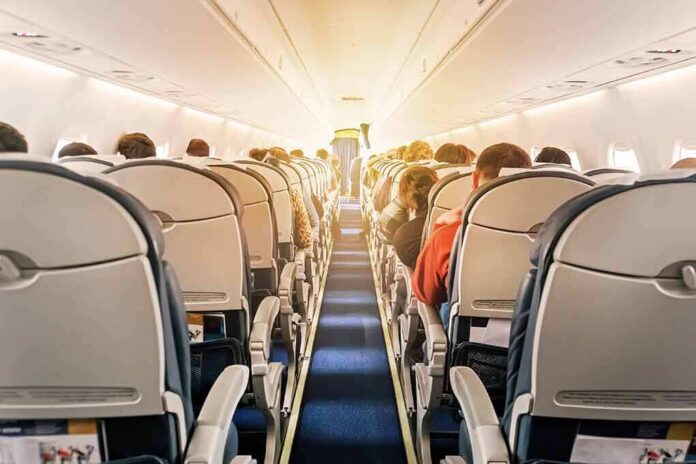
In commercial aviation, words alone can trigger a full security cascade; the system is designed to treat a verbal bomb claim or hijack threat as operationally real until law enforcement resolves it on the ground.
At a Glance
- United Flight 2174 from Newark to New Orleans declared an unlawful-interference emergency after a passenger allegedly claimed he had a bomb; the aircraft landed safely and deputies arrested the suspect.
- Jefferson Parish authorities booked the 34-year-old on state charges of communicating false information of planned arson and terrorizing.
- No explosive device has been reported recovered; the aviation response reflects precautionary doctrine, not proof of a bomb.
- A separate United case, Flight 1681, involved an alleged hijacking text seen by a flight attendant and a cockpit lockdown, underscoring how crews escalate when threats surface.
What Happened on United Flight 2174
United Flight 2174, operating from Newark Liberty to Louis Armstrong New Orleans International, was met by law enforcement after the crew treated a passenger’s alleged bomb claim as an in-flight security threat. According to the Jefferson Parish Sheriff’s Office and contemporaneous reports, a 34-year-old passenger began acting irrationally and told crew members he had a bomb. The crew responded as an unlawful-interference event; public flight-tracking accounts noted the aircraft squawked 7500, the transponder code used to indicate a hijacking or similar unlawful interference. After landing in New Orleans, deputies boarded the aircraft and arrested the passenger without incident; he was booked into the Jefferson Parish Correctional Center on counts of communicating false information of planned arson and terrorizing.
Key details frame the episode’s legal and operational posture. First, the charge selection is state-based and immediate—terrorizing and false arson information—reflecting the most accessible statutes for local authorities to neutralize a perceived airport threat swiftly. Second, the 7500 declaration is a crew-side signal to air traffic control and ground responders that security protocols should activate; while not evidence of an actual device, it dictates a distinct handling of the arrival, including law-enforcement reception and post-landing clearance procedures. Third, no reporting to date has identified a recovered explosive or a bomb squad finding—important to understanding why the response is precautionary rather than confirmatory.
How the Aviation Security Mechanism Works
Air carriers, dispatchers, and flight crews operate under a precautionary model for threat communications. A verbal claim—“I have a bomb”—or an observed hijacking plan is treated as if it could be real because the downside risk of discounting it is catastrophic. The result is an asymmetry: operational responses (cockpit lockdowns, code 7500, diversions or priority handling, law-enforcement meet-and-greets) will often occur even when subsequent law-enforcement work shows no device existed. The same logic applies to hijacking threats conveyed digitally: a text or on-screen message with violent intent, if credibly observed by crew, is enough to escalate procedures immediately. That design principle is not new; it reflects decades of security doctrine refined after high-profile sabotage, hijackings, and cabin disturbances, and it is reinforced by the Transportation Security Administration’s risk-management approach and reporting cadence.
Legally, U.S. criminal frameworks distinguish between the operational duty to act and the evidentiary requirements to prosecute. Federal and state case law shows that conveying false information about an explosive on an aircraft can itself be chargeable, regardless of whether a device exists, because the harm includes disruption and fear induced by the threat. Courts have upheld convictions under false-threat statutes in aviation contexts where the communicative act, not the physical bomb, constituted the offense.
Do Not Confuse Distinct United Incidents
The Newark–New Orleans case on Flight 2174 is separate from a contemporaneous United incident on Flight 1681 out of Las Vegas. In the latter, a flight attendant reportedly saw a passenger’s text threatening to hijack the aircraft—language quoted in subsequent reporting—and alerted the cockpit. The pilots locked down the flight deck and returned to Las Vegas, where the suspect was arrested on threat-related charges. The procedural commonalities—cockpit lockdown, immediate escalation, law-enforcement reception—reflect the same security doctrine; the facts, aircraft, routes, and suspects are different. Keeping these cases discrete helps avoid evidentiary cross-contamination and clarifies what each does and does not establish.
The Flight 1681 record is instructive because it makes the crew’s perception visible through radio calls and complaint language: a threat seen by a trained cabin crewmember triggered a cockpit lockdown and return. That is precisely the behavior airline security programs seek to elicit—rapid information flow to the captain, hardened cockpit, and a return or expedited landing when practical—because it minimizes exposure during the highest-risk window of uncertainty.
Why Crews Squawk 7500—and What It Signals
In transponder parlance, 7500 is the code for unlawful interference. When a crew selects it, controllers and responders interpret the flight as a security event: possible attempted hijacking, bomb claim, or another form of interference. For Flight 2174, public trackers and aviation outlets reported a 7500 declaration prior to landing in New Orleans, consistent with the allegation that the cabin contained a threat communication. The code does not assert the presence of explosives; it marshals resources and reconfigures the handling of the flight. The decision to squawk 7500 is inherently conservative by design—better to be wrong in the direction of safety than slow to act against an actual threat.
On the ground, this signaling yields a predictable playbook: tactical staging by airport police, coordination with federal partners if warranted, passenger containment, and an evidence-preserving deplaning sequence. Parallel to that, airline security and the Federal Aviation Administration document the event, both for regulatory purposes and to support any criminal referrals.
✈️ United flight triggers hijack alert after passenger claims bomb threat.
A suspect attempted to storm the cockpit on a flight bound for New Orleans.
Authorities arrested the individual following the mid-air security incident.#AviationSafety #UnitedAirlines pic.twitter.com/D8K8y4RPaD— WorldScopeX (@WorldScopeX2) November 11, 2026
Legal Pathways After an In-Flight Threat
Post-landing, prosecutors choose among overlapping statutes. Local charges—such as terrorizing or communicating false arson information—are often fastest to file and can hold a suspect pending further review. Federal charging is available under false-information and threat provisions specific to aviation, historically applied when the government can demonstrate that a defendant knowingly conveyed a bomb threat affecting an aircraft in service; appellate decisions have affirmed convictions in those circumstances. Whether a case proceeds federally can turn on investigative findings, prosecutorial discretion, and the evidentiary clarity of the threat communication.
Sources:
facebook.com, apnews.com, wlox.com, 8newsnow.com, tmz.com, nj.com, wionews.com, sbs.com.au
© conservativefreepress.com 2026. All rights reserved.