

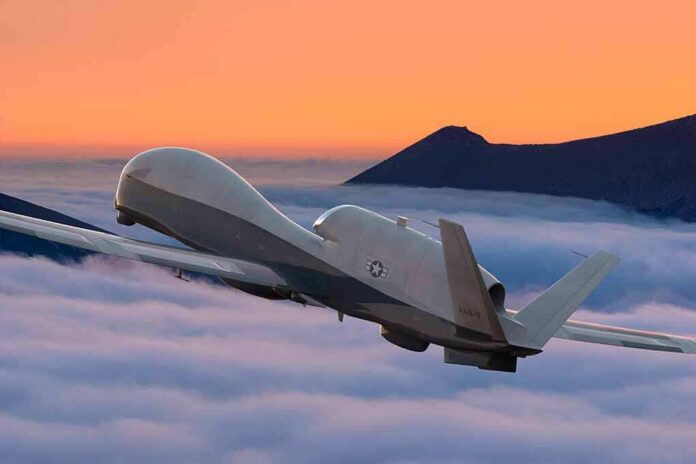
A single clean weapons release is the pivot from “it flies” to “it fights”—and the B-21 Raider just crossed that line at Edwards Air Force Base, entering the phase where a next-generation bomber proves it can carry, separate, and employ munitions as designed.
The Short Version
- The Air Force reports a B-21 test aircraft released a conventional weapon from Edwards AFB in early November 2026, marking its first weapons-release event.
- Program officials framed the test as validating the aircraft’s digital models and the maturity of its open-systems architecture.
- Northrop Grumman independently affirmed the weapons-release milestone as progress toward warfighting capability.
- This is a developmental milestone: meaningful for integration and risk reduction, distinct from operational certification and fielded readiness.
What happened: From flight test to weapons employment
During the first week of November 2026, a B-21 Raider test aircraft flying from Edwards Air Force Base released an unspecified conventional weapon, the aircraft’s first reported weapons-release event. The Department of the Air Force publicly tied the test to validation of the B-21’s digital modeling and open-systems architecture and characterized it as a transition “from flight test to a functional weapons platform.” Independent industry reporting the same day aligned on the timing, location, and conventional nature of the event, and the manufacturer, Northrop Grumman, confirmed the demonstration of weapons-release capability.
Why that phrasing matters is straightforward: flight sciences prove the airplane’s envelope; weapons separation proves it can do its job. Separation testing is unforgiving—geometry, airflow, and timing must cohere so a store clears cleanly without striking the bay or entering hazardous flowfields. A first safe release establishes that the aircraft, its mission systems, and the selected store can be employed together within at least one tested regime. It opens the door to a matrix of additional releases, profiles, and stores that together mature the weapons interface from laboratory to line unit.
How it works: Digital twins, open systems, and the mechanics of separation
The Air Force emphasized two technical pillars: a digital-twin environment and an open-systems architecture. In practice, a digital twin fuses high-fidelity computational models—aircraft aerodynamics, internal bay flow, weapon mass properties, ejector dynamics, guidance initialization—into a predictive environment that can run thousands of simulated releases before a single test sortie. The service linked this event to “thousands of hours” of such modeling, implying the flight fell within a pre-validated trajectory corridor and that measured behavior tracked prediction within acceptable margins.
Open-systems architecture matters for a different reason. Weapons integration is fundamentally an interface problem: mechanical fit and bay environment are necessary, but software—messages, power, timing, employment envelopes, and fault handling—is often the long pole. An open architecture with published interface control and modular software services aims to shorten this path and enable “rapid onboarding” of new stores without deep rewrites. The Air Force cast this release as evidence of that maturity; while specific interfaces and timelines remain classified, the milestone aligns with the B-21’s design intent to onboard capabilities faster than previous generations.
Where this sits in the test campaign: a real milestone, not the finish line
Developmental test answers whether the system can perform a technical task under controlled conditions; operational test answers whether it is effective, suitable, and survivable when used by troops under representative conditions. A first weapons release is a developmental success—consequential but necessarily narrow. The public record does not disclose the weapon type, release parameters, or accuracy results, which is typical at this stage for a stealth bomber. The Air Force and trade press appropriately treated the event as the program’s turn into the weapons phase, a prerequisite to the broader operational evaluation that still lies ahead.
This sequencing fits the Department of Defense’s long-running push to integrate developmental and operational test earlier, using production-representative articles and realistic scenarios sooner to compress timelines and reduce surprises. On the B‑21, the arrival of additional test aircraft and the engagement of operational testers alongside the developmental cadre are the indicators to watch; they signal expansion from single-store separations to a diversified matrix of stores, profiles, and environmental conditions that underpin certification.
Why a first clean separation matters for a stealth bomber
For a penetrating platform, the store leaves from an internal bay, not a wing pylon—this improves survivability but complicates physics. The bay is a cavity with complex unsteady flows; doors must cycle quickly to minimize radar signature growth; ejection must impart the right force at the right moment; and the weapon’s own control laws must survive the buffet and immediately stabilize. A successful first event says the airplane’s bay environment, ejector dynamics, timing logic, and mission systems cohered in flight and that the weapon separated safely. It also validates a portion of the aircraft’s low-observable employment concept: brief door open times, predictable trajectories, and clean avionics sequencing.
Because the B-21 is intended to carry a mixed inventory over its life—conventional and, after separate certification pathways, nuclear—this first release does not imply broad inventory clearance. But it reduces program risk in precisely the domain that has delayed other stealth platforms historically: integrating mission systems and stores without destabilizing aerodynamics or software. That is why both the Air Force and the contractor highlighted it, and why defense outlets treated it as a hinge point rather than a routine sortie.
The B-21 Raider’s weapons release test is an important step toward delivering the adaptable, credible combat capability our joint force needs. Built to rapidly integrate new weapons and respond to emerging threats, the Raider will strengthen deterrence for decades to come. #USAF https://t.co/CrVc7JP8gQ
— Office of the Secretary of the Air Force (@SecAFOfficial) November 15, 2026
What to watch next: scaling from “can” to “can, across the fleet”
Three developments will reveal the depth behind the headline. First, repetition and expansion of the release matrix: different store classes, altitudes, speeds, bay-door timing, day/night, and weather. Second, mission-systems growth: avionics builds that enable more complex weapon modes, multi-weapon sequencing, and target updates, all within the aircraft’s open architecture. Third, operational evaluation and certification: Director, Operational Test and Evaluation findings, the tempo and outcomes at the Combined Test Force, and the march toward initial operational capability at the first operational base. Each step converts a promising one-off into a fielded, reliable capability the force can plan around.
Sources:
defensedaily.com, edwards.af.mil, globalsecurity.org, twz.com
© conservativefreepress.com 2026. All rights reserved.