

A Hollywood name just collided with a brutally ordinary reality: even the rich and famous can’t escape violence, mental-health breakdowns, and a justice system that moves at its own pace.
Quick Take
- Nick Reiner, 32, pleaded not guilty in Los Angeles to two counts of first-degree murder in the deaths of his parents, Rob Reiner and Michele Reiner.
- Investigators allege the couple was fatally stabbed inside their Brentwood home after an argument; prosecutors say key evidence has been turned over, with a full autopsy still pending.
- The case shifted from a high-profile private attorney to the L.A. County Public Defender’s Office after the original lawyer recused himself for ethics-related reasons.
- The district attorney’s office says a death-penalty decision remains under review, while the court set an April 29 date tied to preliminary-hearing scheduling.
Not-Guilty Plea Sets the Legal Track, Not the Facts
Nick Reiner entered a not-guilty plea on February 23, 2026, in a packed Los Angeles courtroom, facing two first-degree murder counts in the killings of his parents, filmmaker Rob Reiner and photographer Michele Singer Reiner. He appeared in jail clothing with a shaved head and spoke little, while his public defender entered the plea. Under California procedure, the plea begins the formal process and sets up the next steps where evidence gets tested.
Prosecutors allege the killings occurred late on December 14, 2025, inside the family’s Brentwood home, with the victims found about 12 hours later by a daughter. Police later arrested Nick Reiner that same day near a gas station in South Los Angeles. Authorities have described multiple sharp-force injuries and noted that a full autopsy report was still pending at the time of the arraignment, leaving some medical details unresolved in public reporting.
What the Timeline Shows—and What It Still Doesn’t
Reporting indicates an argument preceded the killings, but no public motive has been disclosed. That gap matters because it limits what can responsibly be concluded beyond the charging allegations and the known timeline. What is clear is the procedural roadmap: the court set April 29, 2026, for a hearing connected to scheduling a preliminary hearing, where a judge typically decides whether there is enough evidence to hold a defendant for trial.
Prosecutors also indicated they have provided the defense with evidence in the case, except for the full autopsy, which remained outstanding. That detail cuts against the common public frustration that cases “drag” solely because of secrecy; here, at least one key forensic piece had not yet been completed or released. Until that report is finalized and litigated, the public is left with limited, confirmed medical specifics beyond initial examiner findings described in reporting.
Attorney Shake-Up Raises Questions, Not Conclusions
The defense team changed after attorney Alan Jackson, a prominent private lawyer, recused himself in January, citing circumstances beyond his control and ethics-related issues, according to reports. The case then moved to the Los Angeles County Public Defender’s Office, with Deputy Public Defender Kimberly Greene appearing for the arraignment and declining to outline any mental-health strategy. Jackson publicly stated that Nick Reiner was not guilty after what he described as an intensive investigation, but he did not lay out supporting evidence in the reporting.
That combination—an ethics-related recusal and a public insistence on innocence—creates an information vacuum that can tempt speculation. Responsible analysis has to stop short of guessing why the recusal happened or what evidence Jackson relied on, because those specifics were not provided. From a rule-of-law standpoint, the central question remains straightforward: can prosecutors prove each element of first-degree murder beyond a reasonable doubt as the case moves toward the preliminary hearing phase?
Death Penalty Review and a Hard Lesson About Public Safety
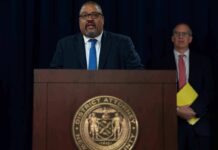
District Attorney Nathan Hochman said the office is reviewing whether to seek the death penalty, weighing aggravating and mitigating factors, according to reporting. That decision is consequential for accountability and for victims’ families who want the strongest lawful response to the most severe crimes. It is also a reminder that justice is not a social-media verdict; it is a structured process with high burdens of proof, especially when the potential punishment is irreversible.
The tragedy also spotlights a broader reality: violence can erupt inside any community, including elite neighborhoods, and family breakdowns are not solved by status, money, or ideology. The research notes Nick Reiner’s past public discussion of addiction and destruction of property at his parents’ estate, but it does not connect those admissions to the killings as a proven cause. For now, the constitutional baseline applies—due process for the accused and a rigorous evidentiary standard—while the public awaits fuller forensic and courtroom disclosures.
Sources:
https://www.latimes.com/california/story/2026-02-23/nick-reiner-murder-charges-arraignment-hearing