
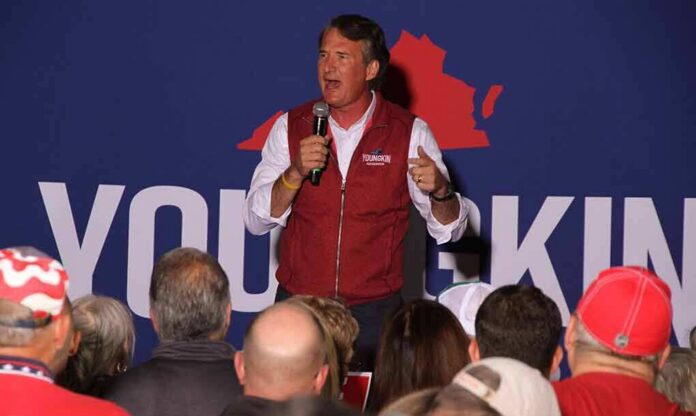
Kid Rock’s Clarksville mic-drop fused a First Amendment lesson with a raw warning about Islamist extremism, and the crowd knew the difference.
Story Snapshot
- Kid Rock warned about Islamist extremists and Sharia at a Clarksville rally.
- He tied the warning to constitutional limits on religious law in public life.
- Local and national outlets confirmed the remarks and the rally setting.
- Courts affirm U.S. law cannot be replaced by religious law such as Sharia.
What Kid Rock Said And Why It Hit Nerves
Kid Rock opened for President Trump at F&M Bank Arena on October 10, 2026. He warned about “Islamist extremists” and said no ideology can trump the Constitution, drawing loud cheers in a campaign-season hall. A local outlet logged the long lines and energy before doors even opened, placing the size and mood of the crowd in view. Fox News framed his remarks as part of the rally’s freewheeling tone and its focus on national direction and constitutional guardrails.
The speech used two lanes. One lane focused on Islamist extremism and Sharia as a coercive project. The other lane hit a broader cultural chord that some critics called anti-Muslim. The narrow lane is easier to defend because it tracks a clear rule: in America, religious law does not override public law. The broader lane draws more heat, because it risks painting millions with the same brush if listeners drop the “extremist” qualifier.
The Constitutional Line That Settles Half The Debate
The rule is simple and strong. The Constitution is the supreme law of the land. No church, mosque, synagogue, or sect can write rules for the government. Courts enforce that line. When Oklahoma voters approved a measure singling out Sharia, a federal court blocked it for targeting a faith. The United States Court of Appeals for the Tenth Circuit upheld that injunction in Awad v. Ziriax, reinforcing both protections for religion and the supremacy of U.S. law.
That two-part lesson matters here. First, government has no power to install religious law. Second, government also cannot punish or disfavor a faith. Both sides of that coin are central to American freedom. They form the backbone of a principled conservative view: keep the state out of the pulpit, and keep the pulpit out of the state. On that standard, Kid Rock’s “no override” line sits on firm ground when aimed at coercion, not private belief.
Where The Facts Are Solid And Where They Are Thin
Reporters captured the core quotes and the rally context. That locks in what he said and where he said it. The stronger claim is the constitutional one: no religious code rules our courts. Courts and legal explainers back that up. They state that Muslims may follow Sharia as moral guidance, but it carries no force in American public law. The weaker claim is the idea of a nationwide plan to impose Sharia. The record cited names no group, plan, bill, or case moving that in the United States.
Kid Rock (@KidRock) declared at President Trump’s Tennessee rally:
“I oppose Islamist extremists whose end goal is to impose SHARIA LAW ON THIS NATION!”
Shortly before these statements, anti-Trump protesters marched on Capitol Hill in Hamas headbands, holding the Islamic… https://t.co/rSnXBhcjAN
— Charles R Downs (@TheCharlesDowns) October 10, 2026
Another weak strand is labeling Islam a “cult.” The United States Department of Justice has told courts that Islam is a major world religion protected by the First Amendment. That is not fringe; it is the government’s stated position in federal court filings. Basic sociology texts also define cults as small, new, and closed. Islam is a global, historic, monotheistic faith by any standard, which makes the “cult” label more heat than light for most readers.
How To Keep The Focus On American Principles
Precision fixes most of the controversy. Target coercion and violence by Islamist extremists, not private worship by peaceful Muslims. Cite the constitutional rule, not a sweeping clash of civilizations. Ask for evidence of any organized effort inside the United States to replace law with Sharia. If proponents have names, documents, or active measures, present them. If not, keep the warning tied to vigilance against terrorism and to the bright line that guards church and state.
Conservatives win this debate by standing on first principles. One, the state cannot enforce any religion. Two, citizens can freely practice their faith within the law. Three, government must stop extremist violence and any attempt to force religious rules on others. That formula is old-school American common sense. It channels the crowd’s energy toward order and liberty, and away from broad claims that cannot stand in court or in the facts.
Sources:
thegatewaypundit.com, clarksvillenow.com, tennessean.com, congress.gov
© conservativefreepress.com 2026. All rights reserved.