
A New York congressional candidate was shoved to the pavement during anti-ICE chaos, but the video tells a tougher story than her CNN sound bites suggest.
Story Snapshot
- Video and reports show anti-ICE protesters driving metal barricades into police lines.
- Darializa Avila Chevalier says she tried to calm tensions when an officer shoved her.
- Clash followed an Immigration and Customs Enforcement shooting that drew a large crowd.
- New York’s protest-policing rules were already under federal scrutiny and reforms.
What the cameras caught, and what each side says
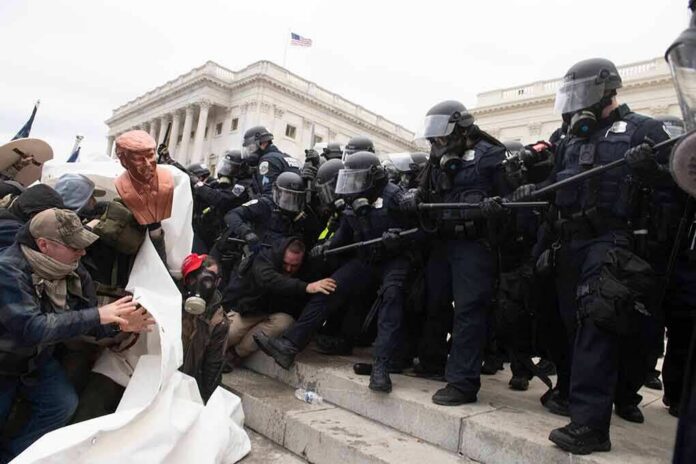
Videos and reporting show a volatile scene outside NewYork-Presbyterian Allen Hospital after an Immigration and Customs Enforcement shooting. The New York Post described protesters pushing metal barricades toward New York Police Department officers as tension spiked. The same reporting placed Darializa Avila Chevalier at the front, where she argued with a supervising officer amid the crush. Another outlet said social video appeared to show a police officer pushing her during the scramble. Chevalier says she tried to “de-escalate” and was shoved to the ground.
CNN amplified Chevalier’s account, including her claim she had been arrested three times at protests yet never thrown to the ground before. Al Jazeera framed the moment as police knocking down a politician during protests. None of these reports dispute that barricades were moving into police or that officers faced a surge. That matters because crowd-control pushes flow from the front line. A push is not pretty. It also does not, by itself, prove misconduct when officers face a forceful crowd pressing barriers.
Why the use-of-force question is hard in a crowd
Use-of-force analysis turns on sequence, threat, and objective. Courts ask whether an officer used force that a reasonable officer would use in the moment. A shove to regain space when a crowd moves barricades differs from a shove used to punish speech. The legal picture around protest policing is knotty. Scholars note that the Fourth Amendment “seizure” standard often fails to fit push-and-move tactics used in crowds, which complicates claims after the fact. That does not excuse abuse. It explains the gray zone.
New York City’s recent history adds weight. A federal judge approved a settlement to overhaul New York Police Department protest tactics after suits over 2020-era practices. The deal aims to end “kettling,” set clearer, step-by-step responses, and tighten command control. These reforms seek fewer flashpoints and clearer lines. The Thursday night clash will be read through that lens. Did officers follow the graduated plan while under pressure from a moving barrier line? Or did they slip back into blunt-force crowd moves?
Chevalier’s narrative versus the on-the-ground dynamics
Chevalier says she was helping to cool things down when an officer shoved her, and that officers, not protesters, escalated force. She also claimed unmarked vehicles pushed through with officers clearing a path. Reporters have echoed parts of her account, but they also cite video of barricades slamming into police and her own confrontation with a supervisor. The most credible picture so far is mixed: a heated front line, hard shoves, and a candidate in the thick of it. That is not martyrdom. It is a hazard of leading from the scrum.
DSA Candidate Knocked to the Ground During Heated NYPD Confrontation at Anti-ICE Protest #DarializaAvilaChevalier #DSA #NYPD #AntiICE #ICEProtest #Bronx #ZohranMamdani #NewYork https://t.co/cjhygpUtCw
— Paul Leon (@PaulLeo2020) October 11, 2026
American conservative values start with order under law and fair dealing. If officers faced a crowd using metal barriers as rams, restoring space with body pushes fits common sense. If an officer singled out a person who posed no threat and threw her down, that crosses the line. The limited record cuts against that simple victim tale. The reported barrier aggression and the push-packed front line make an accidental or control-based shove far more likely than a targeted takedown. Politicians who step into a moving line should expect the line to move them.
What to watch next
Expect internal reviews that check body-camera angles, line-command logs, and hospital security feeds. The Washington Examiner’s note about social video will not be the last frame-by-frame. The New York Police Department will also face questions about whether the graduated protest plan worked under stress. If the plan held and the push fit a brief space-gain, this story fades. If new angles show gratuitous force, discipline follows. Either way, the fix is the same: tight command, clear warnings, and physical lines that do not turn into weapons against police or the public.
Sources:
thegatewaypundit.com, edition.cnn.com, transcripts.cnn.com, cnn.com, tandfonline.com
© conservativefreepress.com 2026. All rights reserved.