

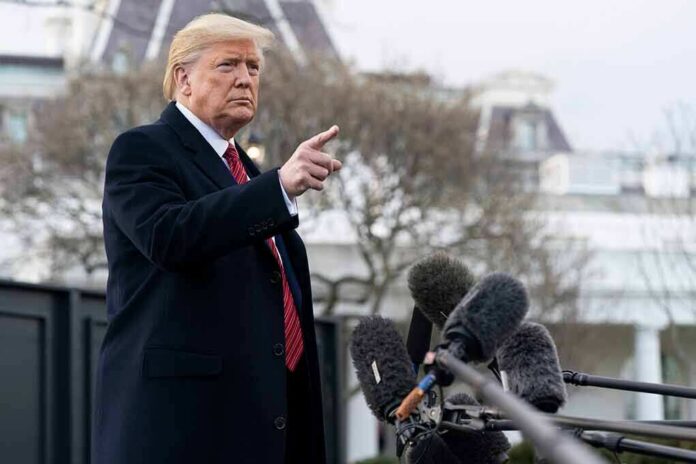
President Trump declared the U.S. military campaign against Iran nearly complete, asserting “practically nothing left to target” as American forces decisively dismantle Tehran’s four-decade regime of regional terror.
Story Highlights
- Trump tells Axios the Iran war will end “soon” with targets exhausted and “any time I want it to end, it will end”
- Operation Epic Fury reduced Iranian retaliatory strikes by 90% while destroying nuclear sites, missiles, and drone capabilities
- U.S. forces destroyed 16 Iranian mine-laying boats in Strait of Hormuz just one day before Trump’s interview
- Administration reversed earlier rejection of Ukrainian anti-drone technology after 7 U.S. service members killed by Iranian Shahed drones
Trump Declares Mission Nearly Accomplished
President Trump told Axios in a March 11, 2026 phone interview that America’s military operation against Iran approaches conclusion because viable targets have been exhausted. “Little this and that… Any time I want it to end, it will end,” Trump stated, framing the campaign as payback for 47 years of Iranian aggression across the Middle East. The President’s definitive tone marks a shift from earlier four-to-six-week timelines, positioning the conflict as ahead of schedule despite Pentagon preparations for two additional weeks of strikes.
#BREAKING: US has 'practically nothing left to target' in #Iran, Trump tells Axios https://t.co/Il7QsmLt9i pic.twitter.com/oR7MkLKpup
— Arab News (@arabnews) March 11, 2026
Decisive Military Superiority Reshapes Regional Power
Operation Epic Fury commenced February 28, 2026, with U.S.-Israel airstrikes systematically dismantling Iran’s ballistic missile arsenals, drone production facilities, nuclear sites, and power projection capabilities. Admiral Brad Cooper, CENTCOM Commander overseeing Strait of Hormuz operations, reported American military strength building while Iranian capabilities decline precipitously. The destruction of 16 Iranian mine-laying vessels on March 10 exemplifies this dominance, eliminating threats to global oil shipping lanes. Iranian retaliatory strikes dropped 90 percent due to missile destruction, vindicating the administration’s aggressive posture against a regime that repeatedly violated nuclear agreements and sponsored terrorism throughout the region.
Strategic Missteps Corrected After American Casualties
The Trump administration reversed course on Ukrainian anti-drone technology after Iranian Shahed drones killed seven U.S. service members, a tragedy stemming from the rejection of Ukraine’s assistance offer seven months prior in August 2025. Defense officials privately acknowledged this dismissal as a “significant strategic blunder,” though the White House emphasized fatalities remained far below initial estimates of 40. Secretary of Defense Pete Hegseth now oversees flexible operations reserving special forces options for securing nuclear stockpiles and scientists, despite public commitments against boots on the ground. This adaptability reflects hard lessons learned from underestimating Iran’s asymmetric drone warfare capabilities.
Alliance Tensions and Economic Pressures Mount
U.S.-Israel coordination faces strain over Israeli strikes on Iranian fuel depots causing oil shortages and price spikes, with Trump wary of domestic political fallout from rising gas prices. Israeli Defense Minister Israel Katz insists on indefinite operations “until objectives achieved,” contrasting with Trump’s claim of unilateral authority to end hostilities. The economic disruption extends beyond energy markets, with Iranian mines threatening Strait of Hormuz shipping and low-cost Shahed drones straining Western air defense budgets. Trump frames the campaign as America’s “last best chance” to prevent Iranian nuclear weapons, a position resonating with conservatives who recognize the existential threat posed by a nuclear-armed theocracy dedicated to destroying Israel and undermining American interests worldwide.
Mission Success Validates Strength Through Deterrence
White House spokeswoman Anna Kelly declared Operation Epic Fury an “undeniable success,” citing the systematic degradation of Iranian military infrastructure that threatened regional stability for decades. Trump’s March 2 address emphasized the accelerated timeline, reinforcing his campaign promise to restore American military credibility after years of failed diplomacy. The operation demonstrates that decisive action against rogue regimes yields better results than endless negotiations with adversaries who exploit weakness. For Americans frustrated by previous administrations’ tolerance of Iranian provocations, Trump’s willingness to use overwhelming force to protect national security interests and defend allies represents a return to peace through strength principles that kept America safe during the Cold War.
The contrast between Trump’s confident assertion of near-total victory and Pentagon planning for continued operations highlights the tension between political messaging and military realities. While skeptics question whether Iran’s asymmetric capabilities are truly exhausted, the objective metrics support substantial progress: missile stocks decimated, nuclear sites damaged, drone production disrupted, and maritime threats neutralized. Whether Trump exercises his stated authority to end the war imminently or operations extend for weeks, the campaign has fundamentally altered the regional balance of power, delivering on promises to confront Iranian aggression that previous administrations tolerated for too long.
Sources:
Axios – US solicited Ukrainian anti-drone aid after rejecting offer
Roya News – Trump says Iran war nearly over, “practically nothing left” to target
Axios – Trump address on Iran war length