

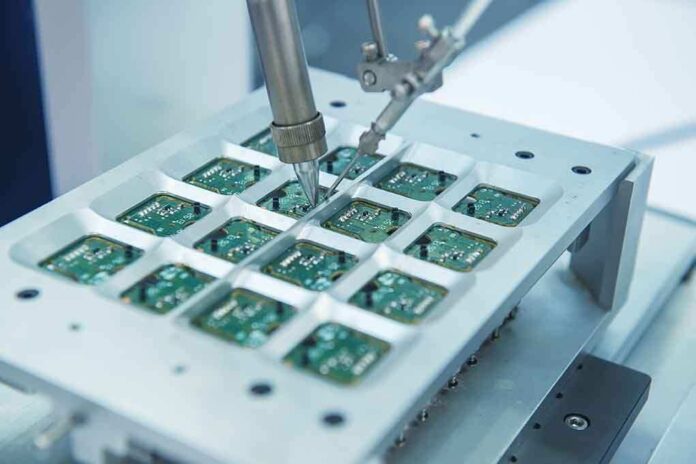
Despite tightened U.S. export controls, Nvidia’s advanced AI chips worth at least $1 billion have been smuggled into China, escalating the tech rivalry between the two nations.
At a Glance
- Nvidia’s AI chips worth $1 billion smuggled into China despite U.S. export controls.
- Smuggling networks exploit loopholes and third-country intermediaries.
- Chinese AI firms continue to access cutting-edge technology.
- U.S. considers expanding export controls to additional countries.
The $1 Billion Smuggling Operation
Nvidia’s advanced AI chips have been reportedly smuggled into China, defying U.S. export controls meant to curb China’s technological advancement. This operation, worth at least $1 billion, illustrates the persistent demand for cutting-edge AI hardware in China’s rapidly advancing tech sector. Despite the Trump administration’s efforts to tighten restrictions in April 2025, Chinese distributors began openly selling banned Nvidia chips to data center suppliers by May. These chips include Nvidia’s high-end H100, H200, and B200 processors, which are crucial for AI development.
The smuggling operation involves sophisticated networks exploiting loopholes and utilizing third-country intermediaries, particularly in Southeast Asia. Countries like Singapore, Malaysia, and Thailand have emerged as key transit points for these illegal transactions. This global supply chain complexity poses significant challenges for U.S. authorities trying to enforce export controls and prevent technology from falling into the hands of potential adversaries.
Stakeholders and Motivations
Nvidia, the U.S.-based AI chip designer, finds itself in a difficult position. While it seeks to maximize sales and comply with U.S. law, it faces pressure from both U.S. regulators and the lucrative Chinese market. Chinese distributors and AI firms are driven by the need to maintain technological competitiveness, relying on U.S.-designed chips for state-of-the-art performance. The U.S. government, aiming to prevent China from acquiring technology that could enhance its military and surveillance capabilities, is determined to enforce these controls.
The smuggling networks involve Southeast Asian intermediaries who facilitate these high-value transactions. These intermediaries are motivated by financial incentives, making it challenging for U.S. authorities to clamp down on these illegal operations. The power dynamics are evident, with the U.S. government holding regulatory power but grappling with enforcement challenges due to the involvement of multiple countries.
Current Developments and Reactions
The Financial Times recently exposed the extent of the smuggling, reporting that at least $1 billion worth of Nvidia AI chips were transported into China in the months following the tightened export controls. In response, U.S. authorities are considering expanding these controls to additional countries, including Thailand, to close existing loopholes. Meanwhile, Singaporean authorities have prosecuted individuals accused of smuggling Nvidia chips to China, with court proceedings ongoing.
Nvidia has stated that building data centers with smuggled products is inefficient and unsupported. CEO Jensen Huang has publicly denied evidence of chip diversion, despite mounting reports. U.S. officials have yet to comment directly on the latest smuggling revelations, but they are reportedly reviewing further restrictions to combat these sophisticated networks.
Implications and Industry Impact
The smuggling of Nvidia’s AI chips into China has significant short-term and long-term implications. In the short term, Chinese AI firms gain continued access to world-leading hardware, blunting the immediate impact of U.S. export controls. In the long term, persistent smuggling undermines U.S. policy objectives, potentially accelerating China’s AI development. This could lead to even stricter global controls as the U.S. seeks to safeguard its technological advantage.
The ongoing smuggling activities raise concerns about the use of advanced AI for surveillance and military applications in China. Politically, this intensifies U.S.-China tensions, complicating trade negotiations and challenging the effectiveness of unilateral export controls. The global semiconductor industry faces increased regulatory scrutiny and compliance costs, with potential shifts in supply chains as companies seek to navigate these complex regulations.
Sources:
Center for a New American Security