The most dangerous moment in a warrant operation is often not the suspect—it’s the structure officers must traverse to reach them.
At a Glance
- A second-story deck in Huntsville, Missouri, collapsed under a joint team of U.S. Marshals and local SWAT during a felony warrant service, injuring seven officers; all survived and began recovery.
- Body-worn camera footage shows the platform dropping almost vertically—leaving little time to react—as the team staged to contact the target apartment.
- The operation focused on sex-offender registration violations; multiple arrests were made the same morning, separate from the collapse itself.
- The event exposes a persistent tactical risk: improvised or aging residential structures can fail under dynamic loads, complicating already hazardous entry operations.
What happened on the deck in Huntsville
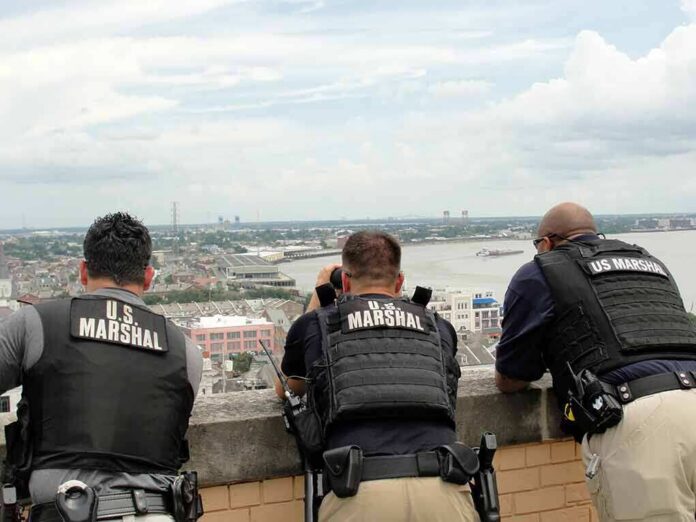
During a felony warrant operation at an apartment complex on Vaunita Street in Huntsville, Missouri, a second-story deck collapsed beneath a combined team from the U.S. Marshals Service and the Moberly Area SWAT unit. According to the U.S. Marshal for the Eastern District of Missouri, Steven Lewis, eight members were on the deck when it failed, sending them down approximately one story; seven officers were injured, including four deputy U.S. Marshals, with no fatalities reported. Contemporaneous reporting based on body-worn camera footage depicts the structure dropping almost straight down—“as if a trap door opened,” as Lewis put it—giving officers little to no time to redistribute weight or leap for a handhold.
The deck failure occurred as officers staged to serve a high-risk warrant in an apartment tied to sex-offender registration violations. While the collapse drew immediate medical response for the injured, the broader operation proceeded: two individuals were taken into custody that morning, with a third located later that day, per local reporting drawn from agency statements. None of the injuries were reported as life-threatening in the initial days after the incident, though some officers faced surgery, consistent with fractures and concussive trauma seen in short-fall entrapments.
Why structures fail under tactical load
Residential decks are deceptively fragile under concentrated, dynamic loads. Many are built to meet minimum local code for occupancy and typical use—family gatherings, not stacked ballistic plates and clustered personnel. When a tactical element “stacks” near a doorway, weight converges over a small footprint; add ballistic vests, breaching tools, shields, and long guns, and a handful of operators can impose short-duration loads that significantly exceed design expectations. If fasteners are corroded, ledger boards improperly flashed, or joist hangers undersized, the safety margins erode quietly until a sudden shear or connection failure triggers progressive collapse. The near-vertical drop in Huntsville suggests a critical connection—often the ledger-to-structure interface—failed first, allowing the platform to pancake rather than peel away.
In complex warrant service, these physics collide with operational imperatives. Teams must control angles of approach, deconflict crossfire, and shield civilians; that often means using existing porches, stairwells, and balconies as the only available elevated ingress. The tradeoff is real: moving to a seemingly sturdier ground-level approach may sacrifice tactical advantage or allow a suspect to flee or arm. The task force accepted that tradeoff, staged on the deck, and the weak link was the structure beneath their boots, not the target’s resistance.
How this risk fits the broader operational picture
U.S. Marshals-led task forces are built for fugitive apprehension and warrant execution—work defined by environments officers do not control. Nationally, the most lethal threats in these operations are firearms and ambush, but structural hazards routinely injure officers as well. Recent U.S. Marshals Service injury reviews enumerate non-gunshot harms—falls, vehicle incidents, and structure-related mishaps—alongside shootings in the tally of occupational risk. The Huntsville collapse is therefore not an outlier in kind, only in its vividness; it underscores that “routine” access points can be as dangerous as the suspect behind the door.
Local reports in the Huntsville case add a familiar urban-services layer: some small jurisdictions do not require routine inspections for certain multifamily properties, which means aged components can persist well past their safe service life. Residents after the incident described the remaining section of the upstairs platform as “getting ready to go,” an anecdotal but consistent indicator that deferred maintenance and exposure had compromised the system before any officer set foot on it. For an operator planning a warrant, this reality translates into an assessment problem: intelligence on a target’s criminal history is usually stronger than intelligence on a balcony’s lag bolts.
Mitigations teams actually use—and their limits
Well-run teams already hedge against structural failure. Common practices include: distributing weight instead of bunching at a threshold; staging one level down and using a contact team with fewer bodies up top; employing ladders to spread load to ground; and delaying stack-in until a visual of critical connections (ledger, post bases, joist hangers) suggests basic integrity. None of these are foolproof. Night service, tight courtyards, barking dogs, or lines of fire may collapse ideal options to a single narrow approach. Weather matters too: rain on smooth decking reduces friction exactly when a sudden shift demands balance recovery, and rot propagates fastest where water and sun meet at the ledger line.
Emerging tools can help at the margins. Lightweight inspection cameras, thermal imaging to suggest voids or moisture intrusion, and even quick-tap acoustic checks on suspect members offer clues without telegraphing presence. But every additional assessment step consumes time and attention in an environment where delay can escalate risk elsewhere. Huntsville illustrates the point: the deck may have been visually ordinary; the failure mode—an inward drop—often hides until loaded.
Aftermath, accountability, and the property question
When collapses and collateral damage happen during lawful police action, the legal aftermath typically separates operational necessity from ordinary tort liability. Courts across multiple circuits have held that property damage incidental to legitimate law enforcement operations is generally not compensable as a “taking” under the Fifth Amendment, absent excessive or unreasonable conduct; the doctrine is uneven at the edges but consistent in its core rationale. In Huntsville, the primary harms were borne by officers, not residents. Still, the event reopens a persistent civic question: in housing stock where inspections are sparse and maintenance is variable, who carries responsibility for keeping ingress structures safe for everyone—tenants, guests, delivery drivers, first responders? Local code officials, property owners, and managers share that duty in practice; tactical teams pay the price when that duty fails.
Operationally, agencies will conduct an internal review that looks less like a criminal inquiry and more like a lessons-learned scrub: loading discipline on elevated structures, alternative approaches considered, medical response times, and coordination with local partners. That cycle—incident, review, procedural adjustment—is how federal task forces harden against the next non-obvious hazard while preserving the decisiveness needed for high-risk arrests. The bodycam record that captured this collapse, widely aired, will likely serve in future roll calls as a visceral training aid on why “watch your footing” is not a platitude but a survivability behavior.
The takeaway for readers who do not kick doors
Two truths can coexist without contradiction. First, warrant service is inherently dangerous; the most disciplined planning cannot eliminate every variable in an unfamiliar structure. Second, many of the injuries officers suffer are preventable through better building maintenance and modest tactical adaptations. The Huntsville deck collapsed because a structural system failed under load; the team’s job required creating that load. Bridging the gap between those truths is not a viral-video story—it’s the slow work of property stewardship, local code capacity, and fieldcraft that respects gravity as much as it respects threat. The officers healed. The next team will benefit if the rest of us learn from what gave way.
WATCH: Deck collapse underneath US Marshals as the task force serves a warrant during a Missouri raid.
The Marshals were targeting a convicted sex offender wanted for failing to register as part of Operation Adam’s Watch
Credit @FoxNews pic.twitter.com/RRb3v3NM8a
— Video Forensics (@Video_Forensics) August 20, 2026
Sources:
facebook.com, youtube.com, krcgtv.com, reddit.com
© conservativefreepress.com 2026. All rights reserved.