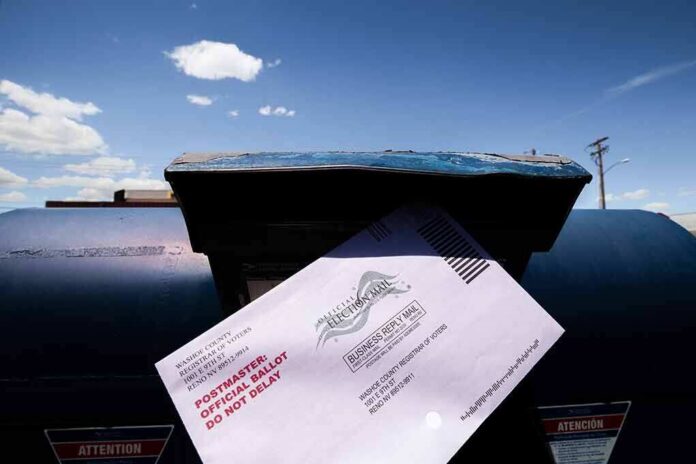
When courts enjoin an agency and the agency keeps building anyway, the issue is not software—it’s governance. The USPS whistleblower’s account of a “rushed, secretive” ballot-mail portal matters because it sits at the collision point of election law, administrative power, and systems engineering, where design choices can quietly determine who gets a ballot and when.
At a Glance
- Two federal court orders in June and August 2026 constrained USPS from implementing key parts of a ballot-mail rule tied to President Trump’s executive order; litigation centered on the 2026 midterms timeline.
- An anonymous USPS whistleblower, via Sen. Richard Blumenthal, alleges portal development paused after the June injunction but resumed weeks later without clear legal authority, and continued despite the August TRO.
- The complaint describes an untested design and a “zero percent” batch-failure rule that could reject or delay mass mailings if a single record mismatched, risking widespread disenfranchisement if implemented.
- USPS counters it would not apply the rule to the 2026 elections unless injunctions lifted, and that development of an optional online tool was permitted under the court’s order.
What the fight is actually about: legal scope meets operational power
Strip away the rhetoric and the dispute is narrow but weighty. Section 3 of the executive order pressed for a new USPS-mediated verification regime for ballot mail, including barcodes and list-matching as a precondition to transmission. A Massachusetts federal court enjoined USPS on June 25, 2026 from implementing those provisions for the November election, and followed with a temporary restraining order on August 27 restricting specified parts of the final rule—Ballot Mail for Federal Elections, 91 Fed. Reg. 54966—amid ongoing litigation. The core stakes: whether USPS could proceed with development work and rulemaking posture during active judicial restraint, and whether the system’s design posed nontrivial risk to timely ballot delivery if and when any injunction lifted.
The whistleblower’s timeline asserts internal work began June 15, paused after the June 25 injunction, resumed around July 29 without stated authority, and continued after the August 27 TRO. That allegation—if corroborated by logs, work orders, or directives—would implicate compliance, not merely judgment. USPS, for its part, told reporters it would not apply the rule for 2026 unless both injunctions lifted, and that the latest order allowed continued development of a voluntary state-facing tool, a narrower reading of the court’s constraint. Those positions are not rhetorically symmetric; one is a claim of prohibited implementation, the other a claim of permitted preparatory work. The boundary between those two is where the case lives.
Mechanics: how the portal and “zero percent” rule would operate
Election-mail systems are brittle at scale because every upstream dependency multiplies failure modes. The portal described in the whistleblower materials would require states to upload records of intended ballot recipients; USPS would then match those lists against outbound ballot mailings using barcodes and addresses. The objection is not to barcodes per se—USPS has long used Intelligent Mail barcodes for bulk workflows—but to the batch-control logic: a “zero percent” failure tolerance in which one mismatch could trigger rejection, hold, or reprocessing for an entire production set. AP’s account quotes the materials directly on batch-level effects, warning that tens of thousands of valid ballots could be delayed because a single record in the batch failed to align.
From a systems-engineering standpoint, that specification invites disproportionate harm. Large-batch gating criteria magnify edge cases—hyphenated surnames, recent moves, data-entry drift—into systemic choke points. In election operations, time is the scarce commodity; a two-day delay near mailing deadlines is outcome-relevant. The complaint also flags insufficient testing and iterative churn under deadline pressure—classic red flags for production risk in mission-critical environments. None of this proves malicious design; it does demonstrate how an optimization for data purity can be maladaptive when the policy objective is timely universal delivery to eligible voters.
The legal record to date: injunctions, a moving appellate backdrop, and a contested gray zone
The Massachusetts docket makes two facts clear. First, the court enjoined USPS from implementing central elements of the executive order’s ballot-mail architecture for the 2026 election. Second, when USPS finalized its rule in late August, the court issued a TRO staying implementation of identified sections of that rule, pending further proceedings. Against that, USPS signaled a readiness posture—finalizing rules so they could “take immediate effect” if injunctions lifted—and insisted it would not apply them for 2026 unless the legal barriers fell.
These are not mutually exclusive claims in theory: agencies often prepare for contingent outcomes during litigation. The trouble arises if the preparation crosses into operationalization. The whistleblower says it did; USPS says its continued work fit within what the court permitted, namely developing an online tool for voluntary state use. Without internal counsel memos, change logs, and build tickets, outsiders cannot yet adjudicate where, precisely, the line was drawn. The court’s August order is concrete; the disputed conduct is factual, not rhetorical, and discoverable.
Credibility and limits of the current evidence
The whistleblower is anonymous to the public. That does not erase the substance—many high-stakes disclosures begin that way—but it constrains independent assessment of role, access, and motive. The strongest details in circulation come through a Senate transmittal and press summaries; they will need reinforcement from primary artifacts: configuration control records, code review notes, email guidance, and automated deployment logs. The “zero percent” rule, while operationally plausible and reported with specificity, still lacks a published technical spec against which independent experts can test projected impact. And the most incendiary claim—millions at risk—remains a scenario analysis, not an observed outcome, because the feature set has not been lawfully deployed at scale.
Set against those caveats, the court orders exist and bite. They show a judge actively restraining USPS around this rule in the same calendar window the whistleblower says work continued. USPS’s public stance—that it was permitted to develop a voluntary tool and would not apply the rule for 2026—is a relevant counterpoint, but not yet a full factual answer to the alleged build and batch-logic choices.
Reading about the USPS whistleblower saying their new ballot tracking system might fail. I was going to vote by mail this year, but now I'm not so sure. Might just go in person.
— BRENEDUARD (@uviCWd8eA35IFSX) September 2, 2026
What would resolve the dispute—and why it matters beyond one election
This is eminently auditable. A short, disciplined discovery plan would surface the truth: internal legal analyses interpreting the injunctions; project plans and sprints from June through late August 2026; access and deployment logs for the portal; and the acceptance criteria governing batch gating and error thresholds. A neutral technical inspection could replicate failure scenarios against anonymized historical ballot data to quantify harm curves at 0%, 0.1%, 1% tolerance bands. None of this requires speculation; it requires records and test harnesses.
The broader lesson endures regardless of the final fact pattern. Late-cycle election interventions by federal actors are uniquely perilous because small errors have outsized, irreversible consequences—ballots delayed close to statutory deadlines cannot be “made whole” after canvass. Courts therefore err on the side of injunctions; agencies must err on the side of restraint. If USPS’s design truly imposed batch-level holds on the theory of data exactitude, that is a category mistake in election logistics. If, conversely, USPS confined itself to lawful contingency planning and a voluntary tool with sensible error handling, then the operational controversy subsides into a legal one about federal reach into state election administration. Either way, the remedy is the same: transparent specifications, testable assumptions, and strict adherence to judicial boundaries.
Sources:
twitchy.com, apnews.com, centraloregondaily.com, mass.gov, votebeat.org, democracydocket.com, theguardian.com, yahoo.com
© conservativefreepress.com 2026. All rights reserved.