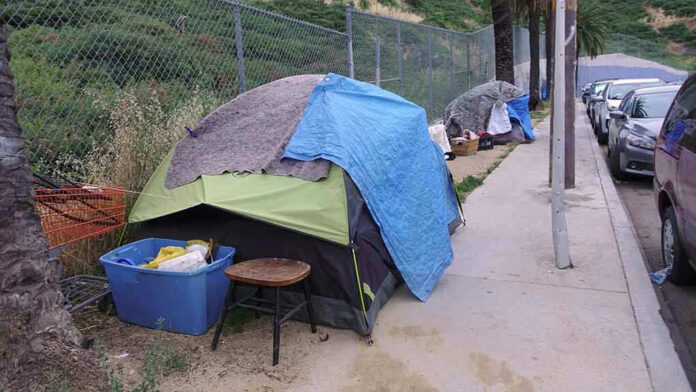
Illinois Democrats are pushing legislation that would strip local governments of their authority to enforce rules against homeless encampments in public parks, igniting a clash between state-level advocates and municipalities fighting to preserve community control.
Quick Take
- House Bill 1429 would override local home rule authority, preventing towns, cities, and park districts from fining or arresting homeless individuals for sleeping, eating, or sheltering in public spaces
- The bill, sponsored by House Speaker Chris Welch and 20 other Democrats, has secured support from 872 homeless advocates and organizations but faces fierce opposition from county governments and local officials
- The measure responds to a 2024 Supreme Court ruling that upheld cities’ rights to penalize outdoor sleeping, prompting Democratic advocates to seek state-level protections for homeless individuals
- Local officials warn the bill would eliminate municipal tools for managing public park safety and sanitation without providing alternative shelter solutions
- The legislation advances a broader pattern of state government overriding local decision-making authority on issues directly affecting community quality of life
Democrats Override Local Control on Homelessness Policy
House Bill 1429, formally titled the Local Regulation of Unsheltered Homelessness Act, seeks to eliminate local governments’ ability to enforce restrictions on homeless individuals in public parks and spaces. The bill prevents fines or criminal penalties for “life sustaining activities” including sleeping, eating, storing property, and sheltering from elements. This sweeping override of home rule authority would apply to towns, cities, park districts, and forest preserves across Illinois, centralizing homelessness policy at the state level regardless of local conditions or community preferences.
Supreme Court Ruling Triggers Democratic Legislative Response
The bill emerges directly from a 2024 U.S. Supreme Court decision in Grants Pass v. Johnson, which upheld cities’ constitutional rights to penalize outdoor sleeping. Rather than accepting this ruling, Democratic legislators and homeless advocacy groups viewed it as a threat to their decriminalization agenda. Advocates argue that local fines and arrests create criminal records that block housing access, effectively trapping individuals in homelessness. This framing shifts responsibility away from addressing root causes—affordable housing shortages and mental health services—toward eliminating local enforcement tools entirely.
Broad Coalition of Advocates Versus Local Authority
House Speaker Chris Welch leads 21 Democratic sponsors, with 872 homeless advocates and organizations filing supporting witness slips before the April 15 Housing Committee hearing. The Chicago Coalition for the Homeless claims penalties “do not facilitate housing” and create barriers to assistance. However, the Illinois State Association of Counties and local park officials oppose the measure, arguing it removes essential tools for managing public spaces without providing shelter alternatives. This dynamic pits state-level advocacy coalitions against municipalities responsible for maintaining parks and ensuring community safety.
Encampment Concerns Drive Local Opposition
Chicago Tribune editorials have documented existing encampments as “unsafe, untenable, and unchanging,” citing hazardous conditions in parks. Local officials warn that eliminating enforcement authority would trigger immediate expansion of encampments as municipalities lose their only mechanism for managing public space usage. Critics emphasize that the bill addresses symptoms rather than causes—it prevents local action against homelessness without mandating state-funded shelter beds, mental health services, or housing solutions. The result would be unmanaged park encampments alongside continued homelessness.
New Illinois Bill Pushed By Dems Would Override Local Rules on Homeless Encampments in Parks and Public Spaces https://t.co/1M8dr3HDRq #gatewaypundit via @gatewaypundit
— Dianna Slonaker (@DiannaSlonaker) April 22, 2026
This legislation exemplifies a troubling pattern where state government overrides local decision-making on issues directly affecting community welfare. Whether homelessness policy should be determined by distant state legislators or by local officials accountable to residents remains a fundamental question about governance and self-determination. As Illinois advances this bill, communities lose the ability to balance compassion for homeless individuals with responsibility for public health and park maintenance—a trade-off that neither advocates nor local officials have adequately resolved through shelter investment or housing solutions.
Sources:
Illinois bill would override local law to allow homeless living in all public parks
Illinois homelessness bill raises local control concerns following Supreme Court ruling
Pending Illinois bill would override local law to allow homeless living in all public parks