

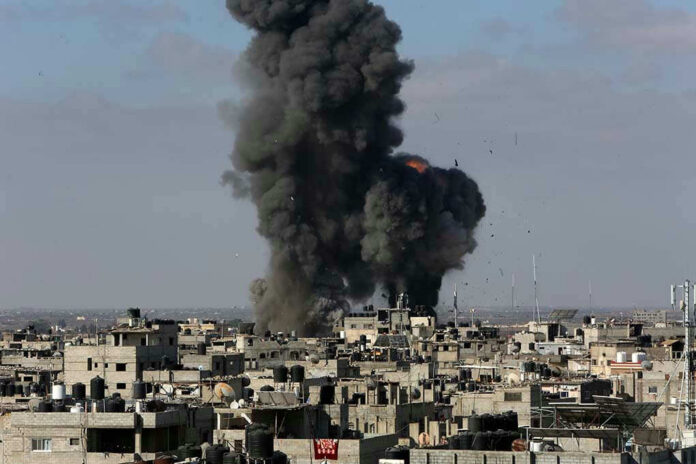
Russia’s latest strike on Kyiv once again exposed how modern war turns apartment blocks into the public face of a much larger battle.
Quick Take
- Photos from Kyiv show the aftermath of a Russian missile and drone attack that hit an apartment building and other civilian areas [1][3].
- Ukrainian officials said the overnight barrage involved hundreds of drones and dozens of missiles, underscoring the scale of the campaign [1].
- Reporting in the search set does not identify a specific military target in Kyiv, leaving Russia’s justification unsupported on the available record [1][3][4].
- The strike fits a broader pattern of repeated attacks that are shaping public debate around civilian harm, air defenses, and the limits of wartime transparency [1][3].
What the Images Show
The photos linked to this story show the wreckage left after Russian missile fire damaged a Kyiv apartment building, with rescuers and debris marking a scene that has become grimly familiar in the capital [1][3]. Ukrainian officials said Russia launched a major overnight attack using drones and missiles, and the damage was not limited to one site. The visible result is another reminder that the war’s cost is being carried by ordinary residents in dense urban neighborhoods.
That public reality matters because casualty-heavy images quickly shape how audiences judge the strike before any deeper forensic review can happen. President Volodymyr Zelenskyy described the barrage as a deliberate tactic designed to stretch air defenses, while the reporting also notes that some incoming weapons were intercepted and others still struck populated areas [1][3]. The facts available here support the scale of the assault, but they do not settle every question about target selection or intended military value.
Why the Targeting Debate Remains Unsettled
The reporting in this search set points to a central gap: it documents destruction, but it does not name a barracks, command post, ammunition depot, or other specific military objective inside Kyiv [1][3][4]. That matters because the difference between a lawful strike and an unlawful one often depends on what was actually targeted, not just on how much damage was caused. Without a Russian Ministry of Defense explanation or independent site-by-site forensic analysis, the public is left with an incomplete picture.
At the same time, the accounts do show why many readers across the political spectrum react with deep skepticism toward official war messaging. Civilian apartment blocks, damaged infrastructure, and missing residents are the kinds of details that make people question whether powerful institutions are being candid about what happened and why [1][3]. In a conflict where each side has incentives to shape the narrative, the absence of verifiable target data creates room for anger, distrust, and competing claims.
A Broader Pattern With Real Costs
This strike should be read as part of a sustained campaign rather than an isolated event. The search results describe ongoing drone and missile attacks on Kyiv and note that Russia has continued large-scale launches over time [1][3][4]. That pattern reinforces a harsh reality for Ukrainians: even when air defenses intercept many weapons, repeated attacks still force civilians to live with the possibility that the next barrage will land on homes, utilities, or shelters instead of military assets.
A rescue operation is currently underway in Kyiv at the site of a Russian drone strike on a nine-story residential building turned into a drone factory– an entire section of the building has been completely destroyed. Hundreds of drones have been destroyed pic.twitter.com/yH1lMKxIWh
— leon (@breteau_leon) May 15, 2026
For American readers, the larger lesson is not about one rooftop or one building alone. It is about what happens when war, propaganda, and public distrust collide in an era when governments on all sides are expected to explain themselves instantly, yet rarely provide enough evidence to satisfy scrutiny. The result is a familiar modern problem: the people most exposed to the consequences are rarely the people who get the clearest answers first.
Sources:
[1] Web – Russia kills several in Kyiv attack as Zelenskyy urges global response …
[3] Web – Russia hits Kyiv with drones and ballistic missiles, killing 1 …
[4] Web – Kyiv strikes (2022–present)