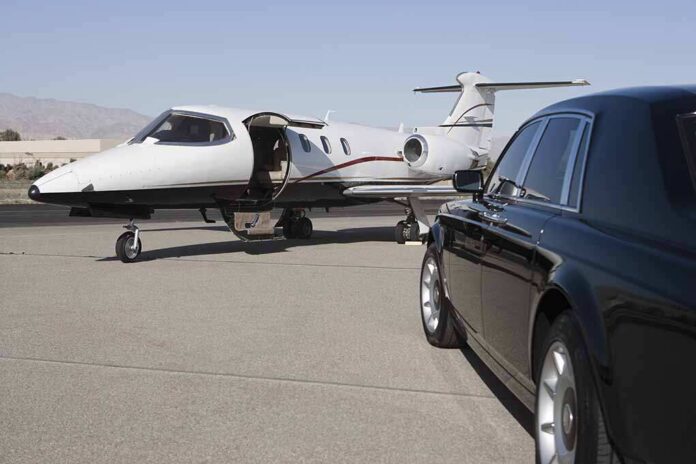
Nearly 100 private jets fled the Bay Area right after Super Bowl LX—another reminder that the people lecturing Americans about “carbon footprints” often live by a different set of rules.
Quick Take
- Local reporting said nearly 100 private jets departed Bay Area airports on Feb. 9, 2026, hours after Super Bowl LX at Levi’s Stadium.
- Researchers have documented a sharp rise in private-jet activity and emissions since 2019, with many flights classified as short, discretionary trips.
- Levi’s Stadium and the NFL promoted sustainability programs, but air travel remains the dominant emissions driver for major events.
- San Francisco-area aviation groups are pushing sustainable aviation fuel (SAF), yet adoption in private aviation remains limited.
Post–Super Bowl Jet Exodus Highlights a Familiar Double Standard
Bay Area air traffic drew fresh scrutiny after Super Bowl LX at Levi’s Stadium in Santa Clara on Feb. 8, 2026. A local report said nearly 100 private jets departed area airports on Feb. 9, with San Jose highlighted as a major hub for the post-game rush. The image is hard to miss: climate messaging dominates elite culture, yet high-emission convenience travel remains normal for VIP events and celebrity schedules.
Elites Did Their Part to Fight Global Warming by Flying Dozens of Private Jets to the Super Bowl
https://t.co/eO8a7Cnwt5— Townhall Updates (@TownhallUpdates) February 9, 2026
The Bay Area story also fits the broader pattern seen at other Super Bowls. Past reporting and research cited in coverage has pointed to far larger aviation surges in other host cities, including hundreds of additional business-jet movements clustered around game day. The exact number varies by venue and airport capacity, but the behavior is consistent: private aviation becomes a “quick in, quick out” transportation system for sponsors, corporate partners, and high-profile attendees.
Private Jet Growth Since 2019 Raises Questions About “Shared Sacrifice”
A key reason this keeps becoming news is the scale of growth. A 2024 study published in Nature documented that private-jet activity increased substantially from 2019 to 2023, alongside a major rise in total emissions. Researchers also found that a large share of private-jet flights were short-distance trips, the kind that look less like unavoidable business travel and more like luxury taxi service in the sky. That undercuts public appeals for ordinary families to accept higher costs and fewer choices.
Super Bowl travel is only one piece of the larger mega-event footprint. Environmental reporting has argued that air traffic tied to major sporting events can double daily aviation emissions around the host region. Even when organizers promote offsets and “legacy” projects, the immediate surge in jet movements produces a visible, local impact: more noise, more congestion, more fuel burn, and more pressure on airport operations. Coverage of multiple Super Bowls has repeatedly described travel as the dominant factor in event emissions.
NFL Sustainability Messaging Collides With Travel Reality
NFL and host-venue sustainability programs can be real—and still fail to address the biggest driver. Levi’s Stadium has been promoted for years as a more sustainability-focused facility, with features like solar energy and other efficiency measures. National coverage around Super Bowl LX highlighted those initiatives, framing them as part of the league’s effort to reduce environmental impact. The problem is simple math: improvements at the stadium can be overwhelmed by transportation emissions when high-end travel scales up.
Reporting around other recent Super Bowls has similarly emphasized that organizers can add electric shuttles, recycling programs, and offsets, yet travel remains the bulk of the footprint. That is the policy lesson conservatives often point to: symbolism and bureaucracy rarely beat incentives and behavior. If public officials and cultural influencers want credibility when they talk about regulating energy use for everyone else, the elite class has to show restraint where it counts—especially when their choices are discretionary.
SAF Push Offers Incremental Gains, Not a Free Pass
Some aviation industry voices argue that sustainable aviation fuel can cut emissions without requiring new aircraft, and Bay Area airports have positioned themselves as leaders in expanding SAF availability. Coverage tied to Super Bowl LX included statements highlighting that SAF can be used as a “drop-in” fuel and that adoption goals are being set. However, reporting also indicated that SAF use among private jets in the region remains small, meaning the practical effect on a surge of Super Bowl-related flights may be limited for now.
The bottom line is that the Bay Area jet rush illustrates a credibility gap more than a technology gap. Americans who spent years dealing with inflation, high energy costs, and lectures about “doing your part” can see the contrast when VIP travel patterns don’t change. The available reporting does not identify individual passengers, and exact emissions totals for Super Bowl LX aren’t publicly tracked in a single standardized ledger. Still, the documented trends and the visible spike in private-jet movements make the broader point hard to ignore.
Sources:
Nearly 100 Private Jets Depart Bay Area After Super Bowl
Super Bowl’s environmental impact: a look at private jet emissions
Super Bowl private jet traffic carbon impact
Sustainable initiatives play crucial role in Super Bowl LX
Sustainable initiatives play crucial role in Super Bowl LX