

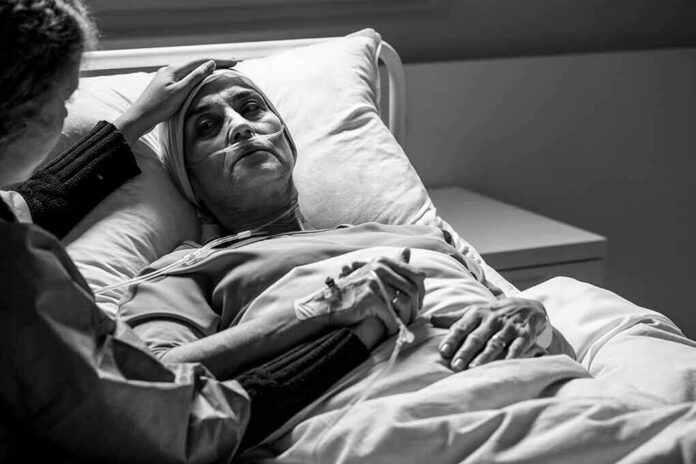
Two daughters say their mom was approved for assisted death hours after release from a suicide-watch ward—and the timeline is not in dispute.
Story Snapshot
- Parliamentary testimony places a suicide attempt and psychiatric hold right before assisted death.
- Family says approval came via malnutrition and frailty, not a terminal disease.
- Police reviewed records and were told she was capable and eligible, according to reporting.
- Daughters demand reforms, citing blocked access to assessment files.
The Clock That Would Not Stop
Parliamentary records show Donna Duncan survived a suicide attempt, was detained on a psychiatric unit, then released and received medical assistance in dying within hours. Her daughters, Alicia and Christie, testified that two assessors approved her on October 24 and 26, 2021, and that she died four hours after leaving the ward. CTV News reported police opened an investigation, underscoring how unusual this case looked at first sight. The timeline is tight, painful, and clear enough to force hard questions about process and judgment.
Reporting says Donna first asked her family doctor for an assisted-death assessment on October 14, 2021. He declined, saying she had not followed treatment advice and that her physical decline tracked her worsening mental health. She then sought other assessors. Two independent reviewers later found her eligible because weight loss and frailty made death “reasonably foreseeable,” a standard that fits the law’s first track. The pivot from “not yet” to “approved” is the hinge on which the family’s outrage—and the policy debate—turns.
Capacity, Crisis, and the Law’s Hardest Call
Police told reporters they learned Donna was of clear mind based on several medical opinions, including her family doctor, and capable of making her own choice throughout the assisted-death process. That conclusion cuts against the family’s argument that a recent suicide attempt signals acute, treatable crisis, not fixed intent to die. Canadian federal guidance admits these are the toughest cases: judging irremediability, separating suicidality from steady choice, and checking real access to care remain the core challenges in assisted dying when mental health and frailty overlap.
The daughters say malnutrition became the qualifying condition and that their mother did not have a terminal diagnosis beyond depression. They describe racing to stop the procedure—calling police, seeking court action, and even securing a Mental Health Act warrant—only to learn by text that their mom had died. They also say health authorities blocked release of the assessment records, which ended the police inquiry without full sunlight on the key clinical notes. This secrecy fuels doubt, invites speculation, and erodes public trust.
What Oversight Missed—and What Reform Should Fix
Federal reporting confirms a gap between monitoring and real oversight; the former tracks numbers, the latter polices quality and errors. That gap shows in cases like this, where families and police want to see the exact checklist, the capacity exam, and the alternatives tried—or refused. Policy should force disclosure after contested deaths: release the two assessors’ notes, consent forms, and decision logs, with limited redactions. Sunshine protects good clinicians and exposes corner-cutting. Common sense and conservative values agree on that basic accountability.
Lawmakers also need a bright-line rule after a suicide attempt. Impose a cooling-off period with mandatory psychiatric follow-up and family-informed care planning, unless a court signs off that delay would cause extreme harm. Require proof that meaningful treatments were offered and tried, not just mentioned. When the reason for eligibility is malnutrition or frailty, demand an independent nutrition and mental-status evaluation by clinicians not tied to the assisted-death team. If the state can end a life, the state must clear a very high bar, every time.
Sources:
lifesitenews.com, theepochtimes.com, linkedin.com, firstthings.com, ctvnews.ca, podcasts.apple.com, macdonaldlaurier.ca, thecatholicherald.com
© conservativefreepress.com 2026. All rights reserved.