

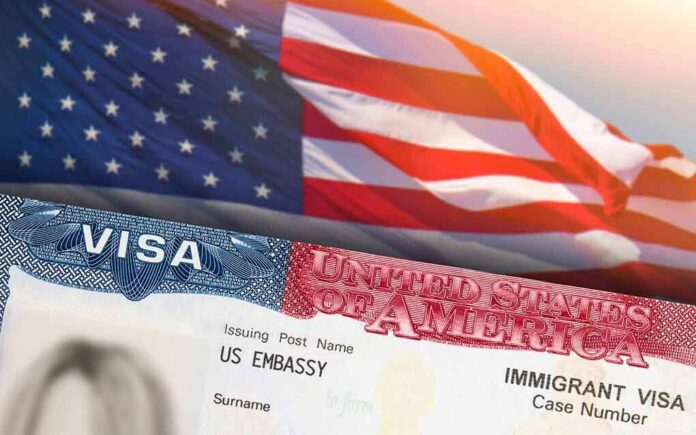
The most consequential feature of the recent immigration shift is not a border surge or a new visa class, but a deliberate collapse in lawful pathways for nationals of Muslim-majority countries — a 96 percent reduction that demonstrates how quickly an administration can reengineer admissions by tightening a few levers across consular visas and refugee resettlement.
The Short Version
- Combined monthly immigrant visa issuances and refugee admissions for 45 Muslim-majority countries fell 96 percent from December 2024 to February 2026.
- Afghanistan and Pakistan saw especially steep drops; Afghan admissions fell from over 5,500 to single digits across the same interval.
- The White House publicly highlighted the decline as a policy achievement tied to President Trump’s second-term approach.
- This pattern aligns with earlier cycles in which security-based restrictions reshaped the religious and regional composition of U.S. admissions.
What the numbers show — and how to read them
Across December 2024 to February 2026, monthly admissions to permanent residence via two lawful channels — immigrant visas issued abroad and refugee resettlement — for 45 Muslim-majority countries fell from 21,096 to 808, a 96 percent contraction. The same series shows country-level collapses, including Afghanistan dropping from 5,563 in December 2024 to 9 by February 2026, and Pakistan down roughly 98 percent over that span. Multiple analyses trace the same State Department-derived series and present the topline as a sustained decline coincident with the start of President Trump’s second term in January 2025.
The headline figure combines two pipelines with distinct statutes and mechanics: immigrant visas (family- and employment-based categories adjudicated by U.S. consulates) and refugee admissions (overseen by the U.S. Refugee Admissions Program under an annual presidential determination). In February 2026 the refugee component from Muslim-majority countries reportedly hit zero — a stark signal that policy or operations had effectively paused that flow, not just slowed it. While the composite percentage does not isolate relative contributions, the directional picture is unambiguous: both channels tightened materially during the period.
Mechanism: how policy levers translate into outcomes
Large moves in lawful admissions rarely require new statutes. Executive authorities and interagency guidance control the tempo and selectivity of flows. On the visa side, the Department of State can modulate interview availability, set evidentiary thresholds more stringently, and apply additional security advisory opinions that slow or deny cases. On the refugee side, the President sets the annual admissions ceiling, and the Department of Homeland Security and State can recalibrate case triage, vetting layers, and regional pipelines. Historically, a combination of pauses, enhanced screening, and lower ceilings has quickly altered the regional and religious composition of arrivals; that pattern recurs here, with the steepest declines accruing to Muslim-majority source countries.
Timing matters. The series cited in public reporting shows a sharp inflection beginning in early 2025, consistent with administrative reorientation in the first months of a new term. Admissions figures typically lag policy announcements because cases in the pipeline must clear new requirements; a cliff in monthly totals suggests either categorical pauses or substantial new vetting checks that significantly reduced final approvals for targeted cohorts.
History and context: this is a familiar template
The United States has cycled through nationality-based restrictions before, framed in terms of security risk, information-sharing deficits, or fraud concerns. During President Trump’s first term, executive actions under Immigration and Nationality Act §212(f) and programmatic changes to refugee processing produced dramatic declines in admissions from countries designated as high risk; the share of refugees from mostly Muslim countries fell sharply as processing slowed and ceilings dropped. While the current reported decline concerns permanent visas plus refugees — not short-term travel — the logic is similar: start with a set of countries linked by perceived security externalities, then raise the evidentiary bar and throttle the pipelines. The outcome is mathematically predictable: far fewer issuances and fewer refugee arrivals, month after month.
That predictability also explains the geographic skew in the current figures. Afghanistan and Pakistan accounted for sizable pre-2025 inflows across family, Special Immigrant Visa–related backlogs, and refugee pathways tied to earlier U.S. military engagement. Apply tougher screens and capacity constraints to those cohorts, and you rapidly depress the aggregate for “45 Muslim-majority countries” — the analytic basket used in the widely cited series.
What the White House embraced — and why that matters
The administration did not treat the decline as a statistical footnote; it promoted it. White House communications highlighted the 96 percent figure, crediting policy for the reduction in legal immigration from majority-Muslim countries. That posture is substantively important: it signals intentionality and claims success on the administration’s preferred metric — fewer approvals and fewer arrivals from these national cohorts.
For analysts, an administration’s public embrace clarifies the causal story. Even without a public inventory of each screening change, the match between timing, magnitude, and messaging supports the straightforward reading: the drop is a policy outcome, not an accident of calendar or seasonal variance. In refugee policy particularly, hitting zero in a given month reflects a decision to suspend or deprioritize cases from those countries, not a sudden absence of qualified applicants.
Republican glee erupts as White House boasts sharp decline in immigration from Muslim-majority nations https://t.co/W1LCqRuVsM #FoxNews
— CountryTarpon (@Countrytarpon) October 1, 2026
Important caveats without losing the plot
Two cautions sharpen, rather than soften, the conclusion. First, the metric counts nationals of Muslim-majority countries, not the religion of applicants. That is standard in immigration statistics — governments record nationality — but the rhetorical shorthand of “Muslim immigration” can obscure that technicality. The underlying finding still stands: admissions for those national cohorts collapsed. Second, the cited monthly series runs through February 2026; later months could move the cumulative totals. Neither point alters the core fact pattern across the period in view, but they define the scope of the claim.
Implications: downstream effects in families, labor markets, and resettlement networks
Sustained contractions in family- and refugee-based inflows compound over time. Family-based immigrant categories depend on petition chains; when approvals fall for 12–18 months, reunifications stall and backlogs age. Employment-based niches that draw from specific countries — health care, engineering, and certain regional language specialties — can face spot shortages if consular issuance slows materially. Refugee resettlement infrastructure, which is funded and staffed against expected caseloads, becomes brittle when arrivals drop to zero from key regions, risking a reversal that is hard to repair quickly if policy later shifts. Those are operational consequences, not ideological ones.
What to watch next
The drivers of decline — ceilings, vetting layers, and consular tempo — are all adjustable. If the policy aim is durable minimal admissions from these cohorts, the system can sustain it with continued screening intensity and low refugee ceilings. If, instead, legal channels are later reopened, recovery will not be instantaneous; rebuilding pipeline capacity, clearing security checks under revised standards, and reactivating resettlement partners typically takes multiple quarters even after a policy turn. Either way, the 96 percent figure is not a statistical anomaly. It is what coordinated executive control over lawful admission pathways delivers when applied consistently across both immigrant visas and refugee resettlement.
Sources:
gbnews.com, hungarianconservative.com, dailywire.com, amren.com
© conservativefreepress.com 2026. All rights reserved.