

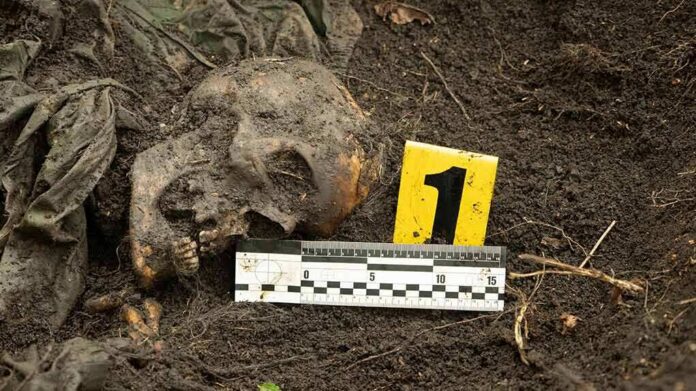
The real question in the Rising Star caves is not whether Homo naledi was “symbolic” like us, but whether the available taphonomic and geological signals clear the high bar for intentional burial—because if they do, the origins of mortuary behavior move from large-brained lineages into a very different evolutionary experiment.
At a Glance
- The burial hypothesis rests on discrete, disturbed subsurface features and articulated skeleton regions interpreted as rapid coverings rather than slow cave accumulation.
- Independent specialists dispute the sediment evidence; a replication effort reports no geochemical distinction between proposed pits and surrounding cave sediments.
- The strongest claims now frame a “minimal cultural burial” hypothesis, not sweeping symbolism—an important recalibration of what the data are said to show.
- This debate fits a long-running pattern in paleoanthropology: exceptional behavior is inferred indirectly, then stress-tested against natural formation scenarios.
What the burial hypothesis actually claims
Proponents of deliberate burial by Homo naledi have tightened their claim over successive drafts. The 2024 version presents a minimal hypothesis: hominins intentionally placed bodies and covered them with sediment, yielding features that disrupted the underlying layers and preserved articulated, matrix-supported skeletal regions consistent with rapid covering before soft tissue decay. The argument is not that naledi practiced elaborate ritual or symbolism; it is that the simplest, behaviorally economical reading of the features is cultural burial in shallow excavations, repeated across more than one deep-cave locale within Rising Star. This repositioning matters: it reduces the evidentiary burden from proving meaning-rich ritual to demonstrating purposeful excavation and covering in a context where gravity, slumping, and slow sedimentation cannot reproduce the observed anatomy-sediment relationships.
In their geological and taphonomic descriptions, the excavators report discrete subsurface disturbances—cut-like features in the Dinaledi Chamber and Hill Antechamber—that encapsulate body parts with sufficient articulation to imply limited postmortem movement, the sort one expects when sediment is introduced quickly around a recently dead body. They further argue that neither talus creep nor gradual infilling should leave this pattern of localized disruption embedded within otherwise stable cave deposits; if the diagnosis is correct, the simplest cause is deliberate digging and backfilling by hominins, not opportunistic natural burial.
The counter-case: replication, reporting, and the null hypothesis
Critics accept that Rising Star poses a genuine taphonomic puzzle but challenge whether the puzzle requires a cultural solution. Two lines of criticism are decisive. First, a multi-author sedimentological reanalysis reports that samples from the proposed burial features and from nearby cave sediments overlap fully in composition; they found insufficient structure in the dataset to distinguish “pit fill” from background sediments. In their view, the geochemical basis for asserting dug-and-filled graves is unsupported by the reported measurements. Second, that team and others argue the original reporting left out key methodological details—such as X-ray settings and acquisition parameters—undercutting reproducibility. When they applied standard field protocols, they did not recover the signature of jumbled sediments near the fossils contrasted with orderly layering elsewhere that the burial interpretation implies.
A separate critique led by María Martinón-Torres and colleagues takes the older, conservative tack familiar from Neanderthal burial debates: before we attribute intent, we must eliminate death traps, gravity-driven movement, water-mediated transport, and carnivore activity as sufficient generators of the assemblage. On their view, the existing record has not crossed that evidentiary threshold; intentional excavation and backfilling have not been demonstrated, and plausible natural processes remain on the table.
Mechanism and threshold: how archaeologists infer a burial without seeing a shovel
Intentional burial is rarely observed directly in Pleistocene contexts; it is a diagnosis of pattern. The strongest indicators occur together: a cut with sidewalls and a base, a fill distinct from surrounding sediments, an articulated body in a constrained position, stratigraphic relationships bracketing a short event, and the exclusion of natural transport. In caves, those signals are complicated by microtopography and episodic sediment inputs. That is why cut-and-fill micromorphology—and unambiguous, reproducible sediment contrasts—matter so much. If the chemistry and microstratigraphy do not reliably differ between a proposed pit and the host sediment, the case leans back toward a null of natural accumulation, even if some anatomical articulations look burial-like. Conversely, if independent micromorphology shows compacted margins, infill fabric inconsistent with adjacent deposits, and articulation mapping consistent with en bloc covering, the cultural hypothesis strengthens dramatically.
Both sides agree, in effect, on the test. They disagree on whether it has been met in the currently published record.
What is not in dispute—and what still is
Some facts now anchor the conversation. The deposits derive from deep-cave contexts that are nontrivial to access today; bodies of multiple individuals are represented; and carnivore signatures and high-energy water transport indicators are not obvious in the primary descriptions. Beyond that, the terrain is live. Proponents say their revised, extended analyses exclude slow sedimentation, gravity slumping, and talus movement as sufficient formation mechanisms; detractors respond that the geochemical and stratigraphic contrasts required to carry that exclusion have not been reproducibly demonstrated and that alternative natural scenarios, including low-energy water or staged accumulation, remain viable. An eLife editorial assessment—in the context of related claims about engravings and fire—judged the overall complex-behavior inferences incomplete, which, fairly or not, frames public reception of the burial claim itself as provisional.
How this fits the longer history of early burials
Paleoanthropology has been here before. Putative Neanderthal graves toggled between “ritual” and “natural process” readings for decades, often on the strength of microstratigraphic details settled years after discovery. The base-rate problem is unforgiving: most Pleistocene bodies were not deliberately interred in ways we can still diagnose; when they were, cut features and distinct fills are rare survivors. That is why the Rising Star dispute matters methodologically. It is a test case for what evidential package—articulation maps, sediment fabrics, geochemistry, and the exclusion of natural mechanisms—earns the label “cultural burial” when symbolism is not the claim and when the agent is a small-brained hominin. The answer will shape not only interpretations of Homo naledi but also how we read other deep-cave accumulations that lack classic grave architectures.
What would resolve the dispute
The path forward is unusually clear. First, independent micromorphological sampling across preserved feature margins, with preregistered protocols and blind thin-section comparisons, could confirm or refute cut-and-fill structures. Second, a fully auditable re-run of the geochemistry—public coordinates, lab settings, raw spectra, calibrations, and code—would test whether pit fills are compositionally distinct from surrounding cave sediments. Third, high-resolution articulation mapping and sediment encasement imaging (micro-CT where feasible) would quantify the speed and manner of covering relative to soft-tissue decay. Finally, process modeling—physical and discrete-element—constrained by Rising Star’s geometry and measured sediment properties, could bound what gravity, talus creep, and low-energy water can plausibly produce. If the burial signature survives those trials, skepticism will erode; if it does not, the field will have learned exactly where the threshold lies.
Judgment today
On the evidence now in public view, the burial hypothesis is serious, specific, and testable, but not yet established. Its backbone—discrete disturbed contexts with articulated, rapidly covered body regions—would be persuasive if the sedimentary contrasts are real and reproducible. The counter-evidence is also specific: a named team reports that the datasets do not differentiate pits from background sediment and that reporting gaps impede replication. In a discipline where extraordinary behavioral inferences must be earned in the fine print of micromorphology and methods, that replication failure weighs heavily. Until independent analyses corroborate cut-and-fill structures and distinct fills, the prudent stance is exactly the one the proponents now articulate: a minimal cultural-burial hypothesis that best organizes their observations but still must run the gauntlet of replication.
Sources:
youtube.com, deephistory.substack.com, elifesciences.org, biorxiv.org, gmu.edu, sciencealert.com, wisconsin.edu
© conservativefreepress.com 2026. All rights reserved.