
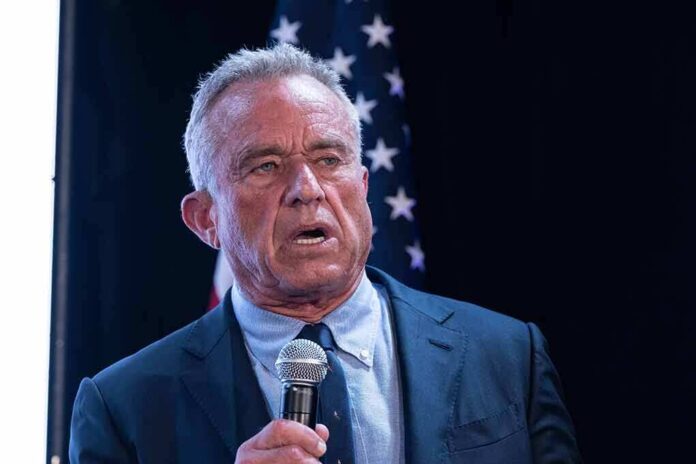
HHS Secretary RFK Jr. has halted all U.S. funding to Gavi, the Vaccine Alliance, demanding they “re-earn public trust” before receiving another dollar of the $9 billion they seek for global vaccination efforts.
Key Takeaways
- Secretary Kennedy announced the U.S. will suspend contributions to Gavi until it addresses safety concerns and stops silencing dissenting scientific voices.
- Gavi is seeking $9 billion in funding for 2026-2030 to provide 500 million childhood vaccinations worldwide.
- The U.S. has been a major contributor to Gavi, providing approximately 13% of its budget with a previous pledge of $2.53 billion from 2022-2030.
- Kennedy’s testimony reflects the Trump administration’s broader approach to restructuring health agencies and prioritizing evidence-based practices.
- Critics argue the funding pause could endanger millions of children in developing nations, while supporters applaud the demand for greater accountability.
Kennedy Demands Accountability from Global Vaccine Alliance
During a pivotal House hearing on June 24, Health and Human Services Secretary Robert F. Kennedy Jr. delivered a firm message regarding U.S. funding for global vaccination efforts. Kennedy announced that American financial support for Gavi, the Vaccine Alliance, would cease until the organization demonstrates a greater commitment to scientific integrity and vaccine safety. The announcement represents a significant shift in U.S. global health policy under President Trump’s administration, with Kennedy emphasizing that billions in taxpayer funding must come with stringent accountability measures.
“The United States won’t contribute anymore to Gavi, the Vaccine Alliance, until the global health organization has ‘re-earned the public trust,'” said the U.S. Health Secretary Robert F. Kennedy Jr..
Billions at Stake in Global Vaccination Funding
The timing of Kennedy’s announcement is particularly significant as Gavi is currently seeking $9 billion in funding for its 2026-2030 operations. According to their projections, this funding would enable the organization to provide 500 million childhood vaccinations and potentially save 8 million lives by 2030. Since its founding in 2000, Gavi claims to have vaccinated 1.1 billion children and saved 20 million lives through its immunization programs in developing nations. The United States has historically been one of Gavi’s largest contributors, providing approximately 13% of the organization’s budget.
“I call on Gavi today to re-earn the public trust and to justify the $8 billion that America has provided in funding since 2001,” he said. “And I’ll tell you how to start taking vaccine safety seriously: Consider the best science available, even when the science contradicts established paradigms. Until that happens, the United States won’t contribute more to Gavi,” said Robert F. Kennedy Jr..
The Biden administration had previously pledged $1.58 billion to Gavi, but Kennedy’s testimony indicates this commitment is now being reconsidered. The Gates Foundation has pledged $1.6 billion to Gavi’s current funding round, hoping to encourage other donors to increase their contributions. However, with the U.S. potentially withdrawing support, Gavi faces a significant budget shortfall that could impact its planned vaccination campaigns across low and middle-income countries.
Broader Health Policy Reforms Under Kennedy’s Leadership
Kennedy’s stance on Gavi funding aligns with his broader efforts to restructure health agencies and redirect priorities within HHS. During the same congressional hearing, Kennedy defended his department’s reorganization plans, which aim to focus more resources on addressing chronic disease while reducing spending levels that increased during the COVID-19 pandemic. Republican lawmakers largely supported these changes, with Representative Buddy Carter praising Kennedy’s approach by stating “America needs a new prescription.”
“When the science was inconvenient, Gavi ignored the science,” said Robert F. Kennedy Jr..
Kennedy specifically criticized what he described as concerning practices by Gavi during the COVID-19 pandemic, including silencing dissenting scientific views and making questionable vaccine recommendations without sufficient safety data. He argued that scientific integrity must be prioritized over established paradigms, particularly when billions in taxpayer funding are involved. Critics from the Democratic side, including Representative Diana DeGette, have expressed concern that these policy shifts could have negative consequences, claiming, “Research labs are closing, Americans are dying waiting for care, promising clinical trials are being delayed.”
Implications for Global Health and U.S. Policy
The potential withdrawal of U.S. funding from Gavi represents a significant shift in America’s approach to global health initiatives under the Trump administration. Supporters argue this stance enforces much-needed accountability in international organizations receiving American taxpayer dollars. The administration’s insistence on evidence-based practices and transparency in vaccine development aligns with President Trump’s broader commitment to putting American interests first in international agreements. Kennedy’s testimony makes clear that continued U.S. support will depend on demonstrated commitment to scientific integrity.
RFK Jr. has announced a full suspension of all U.S. funding to GAVI, the Vaccine Alliance, an organization co-founded by the Bill & Melinda Gates Foundation! 👏🏽👏🏽👏🏽
Since 2001, the U.S. has contributed $8 billion to GAVI, while the Gates Foundation has provided $4.1 billion… pic.twitter.com/oW5KBYcXGd
— Paul White Gold Eagle (@PaulGoldEagle) June 26, 2025
Some health experts have expressed concern that reduced funding could lead to fewer vaccine introductions and diminished vaccination campaigns in developing nations. However, Kennedy and his supporters contend that ensuring vaccine safety and scientific rigor ultimately serves the interests of all recipients. By demanding higher standards from Gavi, the administration aims to strengthen, not weaken, effective global health interventions through improved accountability. The coming months will reveal whether Gavi implements the changes Kennedy has outlined as necessary to restore U.S. financial support.