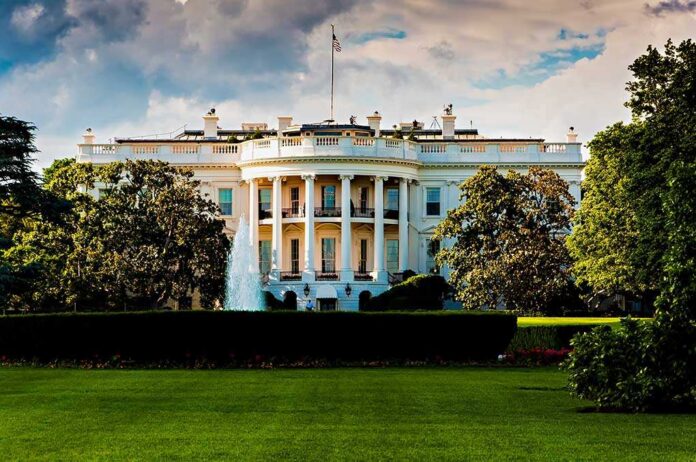
Democrats are blasting a $1 billion Secret Service security line item tied to the White House ballroom while Republicans say the larger $72 billion bill finally delivers the manpower and tools needed to secure the border.
Story Snapshot
- Republican reconciliation bill steers $72B to immigration enforcement and $1B to Secret Service security for East Wing ballroom features [2][3].
- ICE would receive $38B and CBP $26B through FY2029, with added hiring and technology funds [1][2][3].
- Ballroom security funds are restricted to “above-ground and below-ground” security upgrades only, not décor or non-security items [1][2].
- Democrats frame the package as a “Trump ballroom” giveaway; GOP says it protects presidents and the border amid rising threats [2].
What The Bill Actually Funds
Senate Republicans unveiled a reconciliation package totaling roughly $70–$72 billion for immigration enforcement that includes $38 billion for ICE and $26 billion for Customs and Border Protection through September 2029, alongside funding for narcotics-detection technology and hiring Border Patrol and HSI agents [1][2][3]. The same package earmarks $1 billion for U.S. Secret Service “security adjustments and upgrades” related to the White House East Wing ballroom project, specifying allowable “above-ground and below-ground security features” and restricting the spending to security purposes only [1][2].
— Rapid Response 47 (@RapidResponse47) May 6, 2026
Sen. Lindsey Graham has publicly argued that hardening measures, potentially including an underground protective annex, address national security needs and avoid future relocation of high-profile events to less secure venues, stating it would be “insane” to hold a major dinner at a hotel again [1][2]. Sen. Katie Britt emphasized oversight, stressing the security enhancements will serve future presidents and must be handled responsibly [1]. Senate Homeland Security Chair Rand Paul has slated committee action on a related Homeland Security bill providing over $32.5 billion for CBP, reflecting the broader push to surge resources to the border [2].
How Republicans Intend To Pass It
GOP leaders are using the budget reconciliation process to move the enforcement package on a party-line basis, bypassing a filibuster and targeting President Trump’s signature by month’s end if timelines hold [1][2][3]. This approach mirrors long-running congressional practice of folding executive-branch security improvements into larger homeland packages, particularly during periods of elevated threats. Democrats are preparing procedural resistance and delay tactics, including a vote-a-rama later in May, which could slow final passage but will not block reconciliation outright if Republicans maintain unity [2].
Republicans frame the bill as a necessary correction after years of border crises and fentanyl trafficking that strained frontline agencies. The structure spreads funding over multiple years to stabilize recruitment, training, and technology acquisition cycles for ICE and CBP. While backers tout scale and predictability, official, agency-by-agency shortfall documentation was not cited in the available materials, leaving opponents room to challenge whether every dollar is essential at the proposed levels [1][2][3].
The Ballroom Security Fight In Context
Democratic leaders are attacking the Secret Service provision as a vanity expenditure, with Sen. Chuck Schumer claiming Republicans “prioritized a Trump ballroom over families” [2]. The legislative text, however, confines the $1 billion strictly to Secret Service security enhancements, barring use for non-security elements like décor or hospitality amenities [1][2]. The rationale offered by GOP advocates centers on modern threat environments for executive events, where hardened, permanent infrastructure can reduce risk and operational costs compared to frequent offsite protections [1][2].
Questions remain. Reported materials do not include an on-record Secret Service request, public threat assessment, or budget-justification line explicitly calling for a $1 billion ballroom security package, and supporters have not released a CBO score that details the bill’s deficit impact or confirms whether the package is fully debt-financed [1][2]. Additionally, prior public remarks suggested the ballroom project’s construction would be privately financed; the security carve-out uses taxpayer funds, prompting critics to allege inconsistency even as Republicans note the line item is for federal protective functions only [1][2].
Border Security Priorities Versus Political Theater
Republicans argue the heart of the bill remains ICE and CBP capacity: more agents on the line, expanded detention and removal capabilities, and advanced screening tools to disrupt cartels and human smuggling networks [1][2][3]. The enforcement planks are designed to deter illegal crossings and accelerate consequences, aligning with the Trump administration’s broader agenda to restore sovereignty, uphold the rule of law, and protect American communities suffering from narcotics and crime tied to border failures [1][2][3].
Conservatives should watch three metrics as debate unfolds: first, whether Democrats succeed in stripping or shrinking the Secret Service security item; second, whether a CBO score materially alters deficit optics or forces trims; third, whether agency leadership produces public justifications that quantify operational gains from the multi-year ICE and CBP infusions. On substance, the package prioritizes border security. On optics, the ballroom line will draw fire until security authorities plainly document the need [1][2][3].
Sources:
[1] Senate Republicans Push $1 Billion Security Boost For Trump Ballroom
[2] Trump ballroom project security funding included in $72B … – Politico
[3] GOP drops $72B immigration reconciliation bill – Punchbowl News