

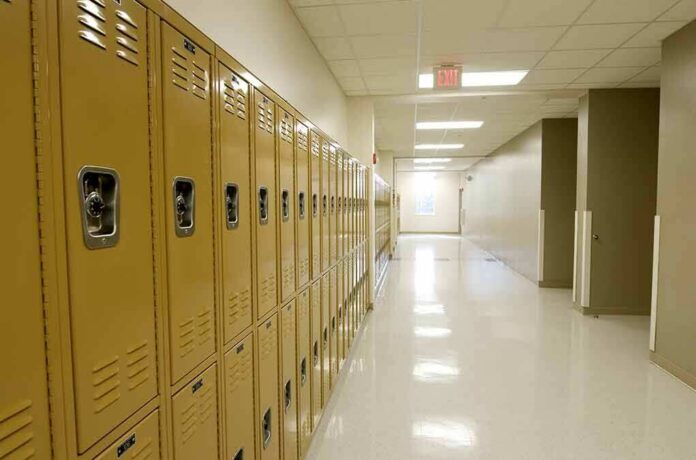
When recording devices turn up in a school locker room, institutions move fast because the law is unambiguous: students have a strong expectation of bodily privacy in changing areas, and secretly filming there is both a serious crime and a categorical violation of school policy.
The Short Version
- Tracy Police say students found a cell phone actively recording in a boys’ locker room at Tracy High School and linked it to head football coach and teacher Jeffrey Pribble, who was arrested within 24 hours.
- Published reports describe students pausing and deleting the recording before turning the device over to staff; detectives later identified the owner as Pribble.
- Locker rooms are legally treated as high-privacy spaces; courts have repeatedly found video surveillance there unconstitutional, and state voyeurism laws broadly criminalize secret recording in changing areas.
- District handbooks already ban student use of recording devices in sensitive settings; administrative investigations typically run in parallel with criminal probes.
What Happened: The Arrest And The Immediate Response
According to the Tracy Police Department’s public release, officers arrested a Tracy High School teacher in connection with the discovery of a recording device inside an on-campus locker room; the arrest followed a report that students had found a phone recording as they changed and handed it to staff. Local reporting identifies the teacher as Jeffrey Pribble, 48, the school’s head football coach; detectives interviewed him on campus before taking him into custody less than a day after the initial report, and the investigation broadened to interview additional students and potential witnesses. Parallel to the criminal inquiry, the Tracy Unified School District opened an administrative investigation and confirmed cooperation with police, a common dual-track approach in K‑12 incidents involving alleged student privacy violations.
One striking operational detail in the early reporting is that students recognized the device was recording, paused it, and deleted the footage before turning the phone over to school staff. Police then tied the device to Pribble and proceeded with the arrest; as in any criminal matter, charges and adjudication follow investigative steps that will test chain of custody, metadata, and corroborating statements, but the institutional sequence—secure the device, identify the owner, isolate the educator from students, open parallel inquiries—matches established school safety playbooks.
Why Locker Rooms Are Treated As Special: Law And Policy
Locker rooms sit at the hard stop of school surveillance. Over two decades of litigation have consistently treated them as spaces of heightened privacy where recording—whether by institutions or individuals—triggers constitutional and statutory problems. In Brannum v. Overton County School Board, the Sixth Circuit held that video surveillance in middle school locker rooms violated students’ Fourth Amendment rights because it significantly invaded reasonable expectations of privacy; the ruling has become a touchstone in school law training and risk management. Education media and practitioner analyses have reinforced the point: cameras may be justified in public hallways or entries but not in areas where undress occurs. On the criminal side, state voyeurism statutes make secret recording in bathrooms and changing areas a prosecutable offense irrespective of whether audio is captured or whether the recorder is a student, visitor, or staff member.
District policies mirror these legal baselines. Tracy Unified’s handbooks restrict the use of recording devices on campus, and district-wide guidance underscores the priority of protecting student privacy and cooperating with police when potential crimes are implicated. The combination of constitutional doctrine and statutory prohibitions explains why schools respond immediately to any credible report of recording in changing spaces: once the fact pattern involves a device in a locker room, delay elevates legal exposure and compounds potential harm to students.
Mechanics Of A School-Based Privacy Investigation
Incidents that begin inside a school typically follow a now-standard choreography aimed at protecting students and preserving evidence. First, staff secure the device and the space. Second, administrators notify law enforcement and central office leadership. Third, police create an evidentiary pathway—documenting who discovered the device, who handled it, what was deleted or altered, and how ownership is established—often by serial number, account credentials, or subscriber records. Fourth, the district launches an administrative review that runs on a separate, lower-proof standard than a criminal case; it can result in paid leave, removal from duties, or termination independent of the state’s charging decisions. This dual system exists because schools must manage risk and safety in real time; they cannot wait for the pace of the courts when the alleged conduct implicates bodily privacy.
The Tracy case so far fits this pattern: the reported same-day device recovery, rapid identification of the phone’s owner, a campus interview, and an arrest; followed by district cooperation and ongoing witness outreach to determine whether other incidents or digital artifacts exist. That sequence is not theatrical; it is designed to stop further harm, stabilize the community, and protect the integrity of any eventual prosecution or employee discipline.
What The Courts Have Already Settled—and What They Haven’t
There is little ambiguity about the baseline rules. Courts have repeatedly invalidated school-operated locker room video as unreasonable, emphasizing the inherent intrusiveness of capturing students undressing. Civil litigation across jurisdictions has produced settlements and policy reforms when institutions strayed from these limits, and professional advisories now treat locker room recording as a bright-line no. Meanwhile, state criminal codes treat surreptitious recording in changing spaces as a distinct offense, often charged alongside related counts if distribution or storage is involved.
What remains case-specific, and thus unresolved until prosecutors and courts do their work, are the granular elements: the precise intent of the person who placed the device, the duration and scope of recording, the number of impacted students, and the digital trail—deleted clips, cloud backups, or prior incidents. Those questions matter for charging, sentencing, and civil liability. They do not, however, dilute the settled principle that students have a robust expectation of privacy in locker rooms and that secret recording there is out of bounds.
A cellphone allegedly recording inside a Tracy High locker room led to the arrest of football coach Jeffrey Pribble, according to police.
The district placed Pribble on administrative leave, while principal Jon Waggle addressed the incident.https://t.co/w7JUISd5QZ
— Dylan Ackermann (@DylanAck10) September 12, 2026
Implications For Schools: Prevention, Training, And Trust
Effective prevention starts with culture and procedure, not technology. Routine inspections of changing areas by two-person teams, explicit staff training on the legal status of private spaces, clear student reporting channels, and immediate, transparent communication with families when credible allegations arise are the backbone of modern practice. Professional risk advisories for schools consistently recommend supervision protocols that respect privacy—adults present and proximate without placing cameras, phones, or mirrored surfaces where undress occurs—and periodic sweeps for unauthorized devices. District handbooks should be precise about prohibited conduct for everyone on campus, including staff, volunteers, and contractors, and align with state voyeurism statutes so that disciplinary responses are coherent with criminal law. These are not box-checking exercises; they are how schools maintain trust when the line between safety and surveillance is most sensitive.
Sources:
nypost.com, kcra.com, stocktonia.org, abc7news.com, cbsnews.com, abc10.com, localnewsmatters.org, edweek.org, mason.gmu.edu
© conservativefreepress.com 2026. All rights reserved.