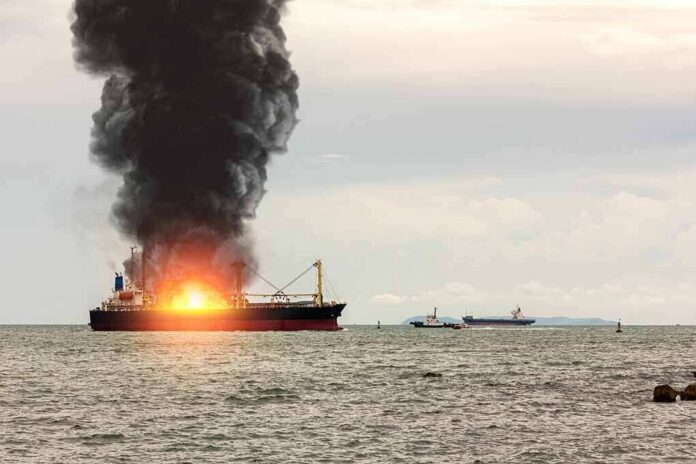
A cargo vessel burned in the Strait of Hormuz after a reported projectile strike, and its crew abandoned ship as security promises collapsed into smoke and salt spray.
At a Glance
- United Kingdom Maritime Trade Operations reported a ship ablaze after a strike near Hormuz
- United States officials said Iran’s Revolutionary Guard fired missiles at nearby commercial ships
- The pattern fits months of seizures and kinetic attacks to assert control over the waterway
- Global shipping risk and energy security concerns spiked as evacuations paused
Fire, Flight, and a Narrow Sea Under Strain
United Kingdom Maritime Trade Operations said a container ship in the Strait of Hormuz was hit by an unidentified projectile and caught fire near the United Arab Emirates coast. The crew issued distress calls and abandoned the vessel as the fire spread, according to the maritime alert. The report placed the strike about 25 nautical miles from shore, a span small boats can cross in minutes, which raises the danger for rescue and salvage teams operating under threat of follow-on attacks.
A senior United States official said Iran’s Islamic Revolutionary Guard Corps launched missiles at two commercial ships near the strait early Tuesday. That account, carried by a major U.S. newspaper, indicates a step beyond warning shots or harassment. It suggests the use of stand-off weapons against civilian shipping traffic in one of the world’s most critical chokepoints. That choice risks wider conflict and puts lives and cargo at the mercy of political gambits.
Escalation After Promises of Safe Passage
Diplomats recently promoted steps to reopen the waterway to normal traffic. Attacks that followed undercut those promises and paused a United Nations plan to evacuate thousands of stranded mariners. The United Nations agency in charge of maritime safety held back because another ship was struck, making convoy organization and tug escorts unsafe. Crews trapped at anchor need clear corridors, not mixed messages and sudden salvos over the horizon.
Analysts tracking the strait describe a shift from radio hails to kinetic enforcement. Reports detail seizures, boarding attempts, and live fire against vessels that did not seek Iranian approval to transit. The strategy uses speedboats, drones, and now suspected missiles to create doubt and delay. The goal appears simple: control the gate and set the rules. That policy clashes with free navigation and invites a hard response from nations that depend on open sea lanes.
A Risk Map for Global Commerce
Ship owners and insurers now factor new risks into every voyage plan. A projectile that lights a deck fire is not just a local story. It drives up premiums, diverts ships around Africa, and squeezes delivery schedules. That pressure can float into prices at the pump and on store shelves. A single narrow sea carries a large share of the world’s energy trade. If tankers hesitate, the ripple hits refineries, truck fleets, and families who count on steady supply more than slogans.
🚨🇮🇷🇴🇲 VESSEL BURNS NEAR OMAN AFTER PROJECTILE STRIKE IN THE STRAIT OF HORMUZ
Iranian state media aired footage it says shows the ship smoking after an overnight attack. Maritime reporting confirms a Dynacom-managed vessel was hit about 8 nautical miles northwest of Kumzar. The…
— Naeem Aslam (@NaeemAslam23) July 20, 2026
United States officials have warned that recent maritime attacks add to a broader pattern of aggression. One outlet summarized claims that at least three strikes since a single weekend targeted civilian ships. That track record shows intent to test the limits of international patience and probe rules of engagement. It also reveals a belief that the world will adapt to new pain rather than push back. History says bullies on the sea stop only when the cost climbs.
What Strength Looks Like at Sea
Free navigation depends on credible patrols, fast interdiction, and clear red lines. Naval coalitions can surge escorts, jam hostile drones, and share radar tracks so no ship crosses alone. Mariners also need simple rules that fit the real threat: dark approaches by fast craft, spoofed radio calls, and one-way attack drones. The fix is not talk alone. It is visible steel and linked sensors that deny surprise. That posture keeps crews safe and markets calm, which is the conservative common-sense goal.
Sources:
bbc.com, youtube.com, wsj.com, reuters.com, conservativeinstitute.org
© conservativefreepress.com 2026. All rights reserved.