

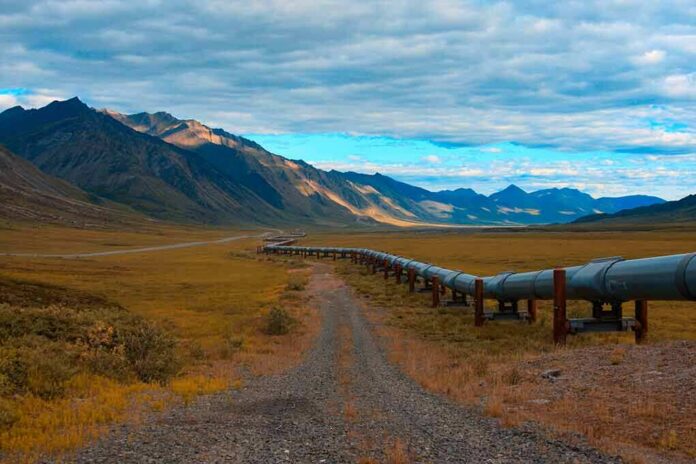
When a single stretch of steel across the Arabian Peninsula can move several million barrels of oil a day, any forced halt is more than a maintenance episode; it is a real-time stress test of global energy security and the political bargains that underpin it.
At a Glance
- Saudi Arabia temporarily shut its East-West oil pipeline after multiple drone attacks, describing the halt as a precautionary measure.
- Saudi officials said the drones were launched from Iraq; the strikes caused fires, some damage, and injuries, according to the government.
- Satellite imagery showing smoke near affected sites supported reports that an incident occurred.
- Riyadh refrained from immediate retaliation, citing Iraq’s request to investigate, even as markets absorbed the supply risk signal.
What happened and why it mattered immediately
Saudi Arabia’s Ministry of Energy ordered a temporary shutdown of the East-West Pipeline after several drone attacks struck facilities in the Riyadh and Madinah regions. Officials framed the move as a precaution to stabilize operations and address damage resulting from the strikes, which triggered fires and injuries among personnel. Multiple international outlets carried the same basic sequence: attack, precautionary halt, and a Saudi attribution that the drones originated in Iraq. Independent of the operational details, commercial satellite images displaying smoke and scorched terrain near the site corroborated that a disruptive incident occurred on the ground.
The East-West system—often described as Saudi Arabia’s safety valve around the Strait of Hormuz—shifts crude from the kingdom’s eastern fields to the Red Sea for export. That role is why even a short interruption carries consequences beyond the immediate repair perimeter: the line underwrites Riyadh’s flexibility to move oil without threading the world’s most volatile maritime chokepoint. In the hours surrounding the announcement, traders treated the event as an acute supply-risk signal, tightening sentiment even before any formal clarity on duration.
How the pipeline functions as Saudi Arabia’s strategic hinge
Mechanically, the East-West Pipeline connects oil gathering networks in the Eastern Province to terminals on the Red Sea, allowing flows to bypass the Gulf and reduce exposure to Hormuz disruptions. Its nameplate capacity has expanded over time with looping and pump upgrades; public references vary from roughly four to seven million barrels per day depending on the period and whether analysts cite design, sustained throughput, or near-term operating rates. Market participants treat the system less as a single number than as a capability: a movable share of Saudi exports that can be rerouted west when Gulf waters are insecure or shipping insurance premia spike.
This architecture is core to Riyadh’s resilience doctrine. By separating production basins from a single egress point, Saudi planners built redundancy against both maritime coercion and local facility outages. The flipside is obvious: attackers do not need to break the entire system to have effect. Hitting pumping stations—nodes that lift and push crude across elevation and distance—can force operators to suspend flows while extinguishing fires, inspecting pressure integrity, and cycling equipment safely back online. That is precisely the logic behind a “precautionary” shutdown; it is about containment and controlled restart, not capitulation.
Attribution, restraint, and the political calculus
Saudi authorities stated the drones were launched from Iraq. The foreign ministry condemned the strike and reported injuries and damage, while signaling that Riyadh would hold off on retaliation at Iraq’s request as Baghdad investigates. The immediate policy choice—pause, repair, coordinate diplomatically—reflects the modern pattern of Gulf energy incidents: operational facts crystallize first, while the chain of responsibility is argued in parallel. Analysts have seen this sequence before, with attribution debates extending longer than the physical outage; the shutdown itself, however, is rarely contested in the record.
That measured stance is not softness; it is strategy. Saudi Arabia preserves options by avoiding an impulsive military response that could widen the theater of risk and impose additional premiums on its own exports. Simultaneously, lodging a clear attribution claim establishes a political ledger for future deterrence or coalition-building to protect infrastructure—on land and at sea—without conceding the evidentiary field.
Market mechanics: why a temporary halt can move prices
Oil pricing is set at the margin; what matters is not global nameplate capacity but the next million barrels traders believe are at risk. Because the East-West line is the kingdom’s principal western outlet, even a short disruption implies either drawdown of Red Sea inventories, rerouting of tankers to the Gulf, or brief export deferrals. Each option raises costs: inventories are finite, Gulf routes may carry higher war-risk premia, and shipment delays cascade through refinery runs, especially for complex plants calibrated to Saudi grades. That is why credible reports of a pipeline halt quickly translate into price action. In this instance, headlines paired with imagery and official statements created a coherent risk narrative, and prices responded accordingly as broadcasters relayed the developments in real time.
The broader context magnifies the effect. In periods when Red Sea and Hormuz security are simultaneously stressed—by militia activity, naval posturing, or insurance constraints—the East-West line’s resilience is not merely a Saudi issue; it is a hedge for refiners from Europe to Asia. When that hedge is dented, the entire forward curve can reprice.
Damage, repair, and operational recovery
Saudi officials reported fires and some damage at the site and confirmed that several people were injured and treated. The decision to shut the line temporarily aligned with standard industrial practice after kinetic incidents: extinguish, isolate, test, and restore. Public reporting in the aftermath emphasized that the shutdown was precautionary rather than an admission of catastrophic failure. In past episodes, Aramco has demonstrated an ability to restore capacity on compressed timelines, aided by spare parts inventories, modular pump assemblies, and parallel line segments; that institutional muscle memory informs market expectations even when exact engineering bulletins are not released.
As in prior attacks against Saudi energy assets, the immediate unanswered question is rarely whether an interruption occurred but how quickly throughput can be normalized across the affected stations. Here, contemporaneous accounts centered on Thursday-morning strikes, with the shutdown communicated the following day; satellite images signaled active fires around Medina consistent with the timeline. Operators typically bring undamaged segments and stations back first, followed by affected nodes after inspection—a sequencing implicitly consistent with a “temporary” and “precautionary” halt.
The pattern: infrastructure as leverage in a contested neighborhood
Energy infrastructure in the Gulf has long been used as a pressure point by state and non-state actors pursuing bargaining power disproportionate to their military mass. The East-West system, precisely because it dilutes Hormuz leverage, has become a symbolic and strategic target. The incident fits that logic: a highly visible node was struck, the pipeline was paused to ensure safety, and a regional political track opened immediately over attribution and response. That cycle—attack, operational containment, political contestation—recurs because it works. It generates attention and risk premia without necessarily inviting full-scale war, and it invites international commentary on maritime and land-route security that attackers hope to shape.
For consumers and policymakers outside the region, the lesson is durable. Diversification of routes reduces catastrophic risk but cannot eliminate coercion incentives; redundancy must be paired with active defense, credible attribution, and coordinated deterrence. Saudi Arabia’s decision to avoid instant military retaliation while publicly naming a launch origin is part of that calibration: shore up the asset, hold the diplomatic line, and leave the door open to collective security measures if deterrence fails.
SAUDI PIPELINE SHUTDOWN SENDS BRENT PAST $104
Saudi Arabia halted its East-West pipeline this week after drone attacks, cutting off a route that carries roughly 4% of global oil supply and serves as the kingdom's main bypass around the Strait of Hormuz. Traders watching $BNO saw…
— Jose Rosell (@arturillo955) September 14, 2026
What to watch next
Three indicators matter for the medium term. First, the speed and sequencing of restart across pumping stations will tell markets more than any single capacity number; flow normalization is the hard metric. Second, Iraq’s investigation and any joint Saudi-Iraqi forensic disclosures will shape regional diplomacy over cross-border drone launch controls and air-defense cooperation. Third, maritime conditions in the Red Sea and Gulf will either amplify or dampen the pipeline’s strategic value at any given moment; when sea lanes are quiet, the line is insurance, but when they are tense, it becomes indispensable.
Sources:
feedpress.me, bbc.com, arabnews.com, thenationalnews.com, cnbc.com, pbs.org, argusmedia.com, cnn.com, nytimes.com, reuters.com, euronews.com
© conservativefreepress.com 2026. All rights reserved.