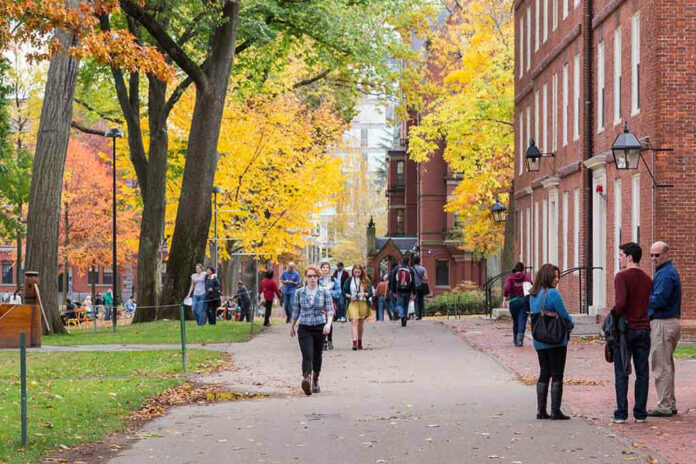
Once-revered Ivy League institutions are losing their grip on American prestige as families rebel against DEI-driven agendas and seek true academic excellence in the South.
Story Snapshot
- Parents and students are abandoning Ivy League schools due to DEI policies and campus controversies.
- Southern universities are attracting record applications, reshaping the elite college landscape.
- Concerns about antisemitism and free speech are fueling distrust of Northeastern “woke” campuses.
- Experts debate whether the shift is permanent, but Southern schools are gaining influence and prestige.
DEI Controversies Trigger Flight from Ivy League
Traditional Ivy League colleges—once the gold standard for American higher education—are facing a crisis of confidence among parents and students. Over the past five years, mounting controversies over Diversity, Equity, and Inclusion (DEI) policies, coupled with a spike in campus antisemitism and unrest, have eroded trust in these elite institutions. Families frustrated by leftist activism and the suppression of free expression are now questioning whether Ivy League degrees are worth the cost, prestige, or potential risk to their children’s values and safety.
From 2020 to 2024, Ivy League campuses became flashpoints for divisive debates on speech, identity, and political activism. The adoption of test-optional admissions, originally introduced during the pandemic, further fueled concerns about declining standards and opaque selection criteria. Faced with public backlash, some schools have stopped releasing full admissions data—a move critics argue undermines transparency and accountability. Meanwhile, reports of antisemitism and administrative failures to protect students’ rights have intensified parental alarm, prompting many to seek alternatives outside the “woke” Northeast.
Southern Colleges Rise as New Elite Destinations
Southern universities—long respected but rarely considered equals to the Ivy League—are now seeing unprecedented interest from top students nationwide. Families looking for rigorous academics, campus safety, and respect for traditional values are turning to institutions such as Duke, Vanderbilt, Rice, and Emory. These schools have invested heavily in state-of-the-art facilities, world-class faculty, and programs in high-demand fields like business and engineering. The Common Application’s expansion has made it easier than ever to apply, further driving up selectivity and national recognition for these “Southern Ivies.”
Admissions data confirm a surge in out-of-state applications to Southern colleges, with some institutions reporting double-digit growth since 2022. The shift is most pronounced among families disillusioned by Ivy League controversies, who see in the South a commitment to academic excellence, merit-based admissions, and a campus culture more aligned with American values. Southern colleges are not only gaining prestige—they are challenging the definition of what it means to be “elite” in higher education.
Redefining Prestige: Changing Perceptions and Long-Term Impact
This transformation is not without debate. Some higher education analysts caution that the Ivy League’s historical prestige and selectivity remain unrivaled, and that the “Southern Ivy” trend is overstated by media focused on cultural conflict. However, the numbers tell a compelling story: both Ivy League and Southern schools are more competitive than ever, but the South is closing the gap. For many families, the appeal of a rigorous, politically balanced, and career-focused education in the South now outweighs the fading allure of the old Northeastern elite.
DEI Killed the Ivy League: Elite College Admissions Shift to the South, Parents Ditch Woke 'Elite' Colleges via @WestJournalism https://t.co/gr0qSfcyZ0
— John Rogers (@rogers86321) August 18, 2025
In the short term, Southern colleges are benefiting from increased tuition revenue, more geographically diverse student bodies, and surging alumni pride. Over time, this could trigger a rebalancing of influence in American higher education, with elite status no longer defined by geography or ideology but by a genuine commitment to excellence, liberty, and free inquiry. For conservative families seeking the best for their children without sacrificing their values, the elite college map is being redrawn—and not a moment too soon.
Sources:
Shemmassian Consulting (Ivy League acceptance rates)
Ivy Coach (Ivy League admissions statistics)
Top Tier Admissions (Rising popularity of Southern colleges)
College Essay Advisors (2025 admissions statistics)
College Transitions (Southern Ivy League schools ranked)